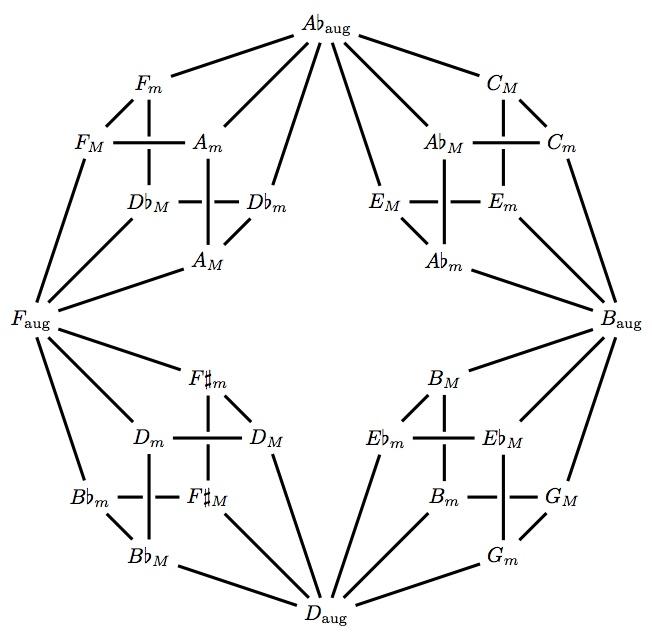
C E G
If we lower the E a half-step, we get a C minor triad, called Cₘ here:
C E♭ G
If we then lower the C a half-step, we get a B augmented triad:
B E♭ G
(Yes, I know musicians don't write the B augmented triad this way. Forgive me, I'm trying to make it easy for nonmusicians.) We can now move to the next cube by lowering the G a half-step:
B E♭ G♭
This is a B minor triad, Bₘ.
Note that there are 12 major triads, 3 in each cube. There are 12 minor triads, 3 in each cube. But there are only 4 augmented triads. That sounds paradoxical! It's because we're counting two triads as the same if their notes are rearranged (musicians say 'inverted'), and this means we count a lot of augmented triads as the same. For example we can take the B augmented triad
B E♭ G
and rearrange it like this:
E♭ G B
and it's another augmented triad - but in this picture, we're counting it as the same. The difference is that unlike the major and minor triads, the notes in an augmented triad are equally spaced, giving an extra symmetry.
The cube dance was invented by Douthett and Steinbach in 1998, and I got this nice picture from Alexandre Popoff, who explains it on this web page, and shows how it appears in rock music:
https://alpof.wordpress.com/2019/09/22/transformational-music-theory-16/
I recently went to Alexandre Popoff's thesis defense - he did his PhD on category theory in music, and I was on his thesis committee. It was great! He passed, and I look forward to him putting his thesis on the arXiv and publishing it.
(2/n, n = 2)