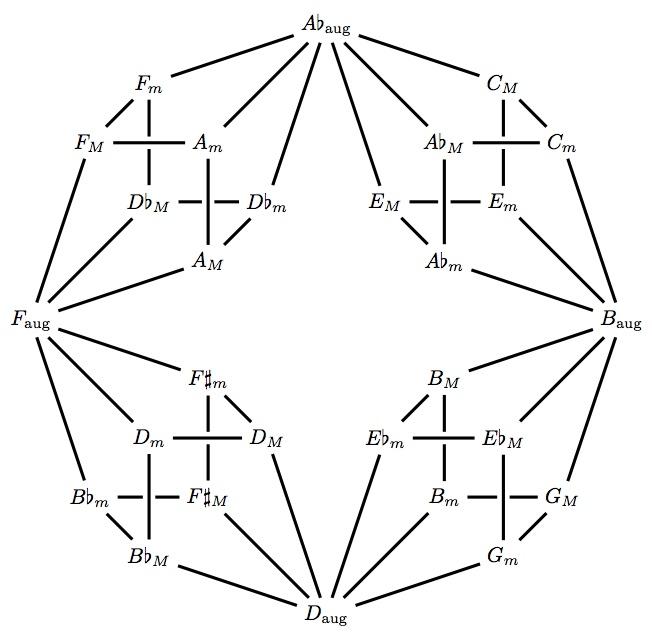
Augmented chords are choke points: if you want to get from one cube to another, you have to go through an augmented chord.
For example a C major triad, called Cᴍ here, consists of the notes
C E G
If we lower the E a half-step, we get a C minor triad, called Cₘ here:
C E♭ G
If we then lower the C a half-step, we get a B augmented triad:
B E♭ G
(Yes, I know musicians don't write the B augmented triad this way. Forgive me, I'm trying to make it easy for nonmusicians.) We can now move to the next cube by lowering the G a half-step:
B E♭ G♭
This is a B minor triad, Bₘ.
Note that there are 12 major triads, 3 in each cube. There are 12 minor triads, 3 in each cube. But there are only 4 augmented triads. That sounds paradoxical! It's because we're counting two triads as the same if their notes are rearranged (musicians say 'inverted'), and this means we count a lot of augmented triads as the same. For example we can take the B augmented triad
B E♭ G
and rearrange it like this:
E♭ G B
and it's another augmented triad - but in this picture, we're counting it as the same.
The cube dance was invented by Douthett and Steinbach in 1998, and I got this nice picture from Alexandre Popoff, who explains it on this web page, and shows how it appears in rock music:
https://alpof.wordpress.com/2019/09/22/transformational-music-theory-16/
I recently went to Alexandre Popoff's thesis defense - he did his PhD on categories in music, and I was on his thesis committee. It was great!