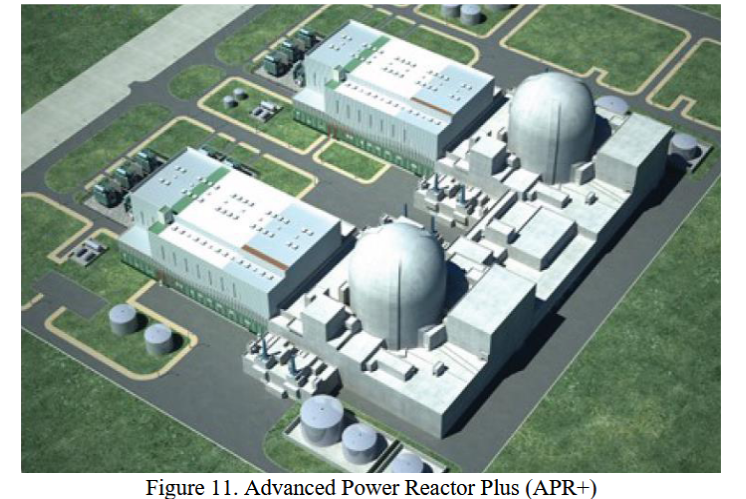
KEPCO recently re-added a page in their website about the APR+.
A successor to APR1400:
- Power: 1500 MWe
- Construction time (NOAK): 36 months (3 years)
- 100% domestic design (No IP drama)
Additionally:
- Economic target: 10% "better" than APR1400
- Passive emergency cooling
- Core Damage Frequency: < 1 event per million years.
- "10x safer than APR+"
Despite the promise that this reactor showed, it never materialized. What happened?
Brief History:
2007: Feasibility Study Started
2009: Start of the Standard Design Development
2014: Secure Standard Design Certificate in Republic of Korea
2014 (?): Agreement signed to build the Cheonji Nuclear Power Plant, with two APR+ units.
2017: President Moon Jae-In (anti-nuclear) was sworn in. The Cheonji NPP project was scrubbed.
Fast construction time
Target construction time: 3 years.
How feasible is this? Let's see the track record:
Korea: Avg = 56 months, Record = 49 months
Japan: Avg = 46 months, Record = 39 months (Kashiwazaki-Kariwa Unit 6)
This represents an improvement of ~1/3 off Korea's average.
1) On one hand, while a great challenge, it might not be impossible, given the speedup better modularity can bring. Plus, Japan demonstrated times around ~3 years are possible (although it was for a BWR, which constitute the majority of Japan's fleet and not a PWR). Plus, KHNP does have a great track record.
2) On the other hand, China, which is quite adept at building mega projects fast, has not been able to match these times. It remains to be seen the performance they achieve on the CAP1000 (based on the AP1000, also a "Large Modular Reactor").
Where does this leave SMRs?
SMRs are not expected to reach the economic performance ($/MW and $/MWh) of Large Reactors for electricity generation.
They are marketed for their lower financial risk and fast construction times.
However, Large Modular Reactors (LMRs) could prove that the keyword is "Modular", in what concerns fast construction times and lower cost. Such LMRs could prove even more competitive relative to SMRs.
LMRs could therefore provide also much improved construction cost and financial risk/cost (which is a major component).
What now?
Unfortunately, ever since 2017, the APR+ seems to have gone into a slumber. KEPCO and KHNP removed all references to it, and even their documents at IAEA were deleted (not before I managed to grab one of them, luckily. Will link below).
One can only be optimistic that the fact KEPCO re-added them in their page means it is not dead.
Links
- KEPCO page: https://home.kepco.co.kr/kepco/indi/foreign/fr/html/G/F/FRGFHP002.html
- IAEA June/2020 Status Report
(Which I managed to grab before deletion):
https://drive.google.com/file/d/12dIquUOYvT8rfKEZt1DbXilq0avB9w7R/view?usp=sharing
- Subscribe to Substack (will write soon)
https://diogovalada.substack.com
[Original text from Diogo Valada, as posted on X]