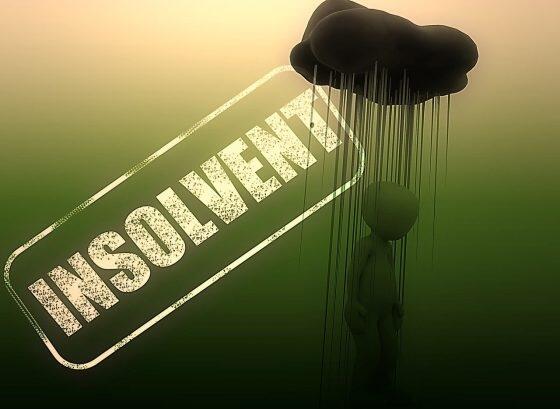
Is the fact that large companies are filing for bankruptcy at the fastest pace in 15 years a good sign for the economy or a bad sign for the economy? I don’t even have to answer that question because all of you already know the answer. And as you will see below, other types of bankruptcies are soaring as well. We are a nation that is absolutely drowning in debt, and now bubbles are bursting all around us. I hope that you have positioned yourself for what is about to happen, because the months ahead are going to be rough.
The U.S. saw a sharp increase in corporate bankruptcy filings in July, according to a recent report, reaching a post-COVID peak and placing 2025 on track to surpass last year’s total.
S&P Global Market Intelligence, the research and data arm of the credit-rating agency, found that filings by large public and private companies rose to 71 last month from 66 in June, marking the highest monthly tally since July 2020. So far in 2025, meanwhile, the total of 446 bankruptcy filings is the highest for this seven-month stretch since 2010.
In 2010, we were experiencing the tail end of the global financial crisis.
So there was a very good reason for why so many large companies were going bankrupt at that time.
What reason do we have for what we are witnessing right now?
Personal and business bankruptcy filings rose 11.5 percent in the twelve-month period ending June 30, 2025, compared with the previous year.
According to statistics released by the Administrative Office of the U.S. Courts, annual bankruptcy filings totaled 542,529 in the year ending June 2025, compared with 486,613 cases in the previous year.
Business filings rose 4.5 percent, from 22,060 to 23,043 in the year ending June 30, 2025. Non-business bankruptcy filings rose 11.8 percent to 519,486, compared with 464,553 in the previous year.
Wow.
I had no idea that the bankruptcy numbers were that bad.
An 11.5 percent increase in bankruptcy filings in just one year is a really troubling sign.
Hit with high interest rates and labor shortages, more American farmers are filing for bankruptcy, according to new data from the University of Arkansas.
Researchers found that more than 250 farms filed for Chapter 12 bankruptcy between April 2024 and March of this year, marking a sharp increase in financial distress across the agricultural sector.
“We’ve already beat last year in terms of Q1 national filings,” said Ryan Loy, an economist at the university. “Once you see this on a national level, it’s a clear sign that financial pressures that we saw before in the 2018 and ‘19 are kind of reemerging.”
A lot of people out there are in denial about what is really happening to the economy.
We have been on an unprecedented debt binge for many years, and now we are beginning to experience the consequences.
Millions upon millions of Americans are in way over their heads, and there is no easy way out.
The study of 1,078 adults by Self Financial exposes a nation drowning not just in debt, but in the shame that comes with it. Of those carrying debt, 66.3% admitted to minimizing or hiding it from others. This breaks down to 28.1% outright lying about their situation, 20.8% downplaying how bad things really are, and 17.4% avoiding the topic entirely.
We may want to hide our financial distress from others, but there is no way to hide it from ourselves.
At 54%, a little more than half of the 2,206 adults surveyed said they’re thinking about it more than they did last year. In fact, the June survey found 53% of Americans said they’re feeling financial stress “more acutely than ever,” including 62% of Gen Xers and 41% of baby boomers.
Grocery prices have been climbing and one area where prices have hit a record high is beef, a staple for many households.
Ground beef, usually the inexpensive choice for shoppers, has hit a record high. Shoppers can expect to pay $6.25 per pound, up from $5.49 a year ago and $4.26 five years ago, in July of 2020.
The average price for beef steaks has hit $11.87 a pound as of July. That’s up from $10.85 in July of 2024 and $8.69 in July of 2020.
A more than 30% year-over-year rise in retail prices for coffee is staggering — and consumers are not likely to see relief anytime soon, even as a merger between two beverage giants looks to create an entity that can better manage rising costs.
If we stick our heads in the sand and keep repeating “everything is going to be okay”, will that make things better?
Of course not.
We need to realize what is happening and adjust our plans accordingly if we are going to navigate through this very harsh economic environment.
For one thing, if you have a good job right now please do not give it up unless you absolutely must do so.