---
### **What’s Happening in the Thread**
1. **BIP-110 Failed to Activate**
The thread references a [meme image](
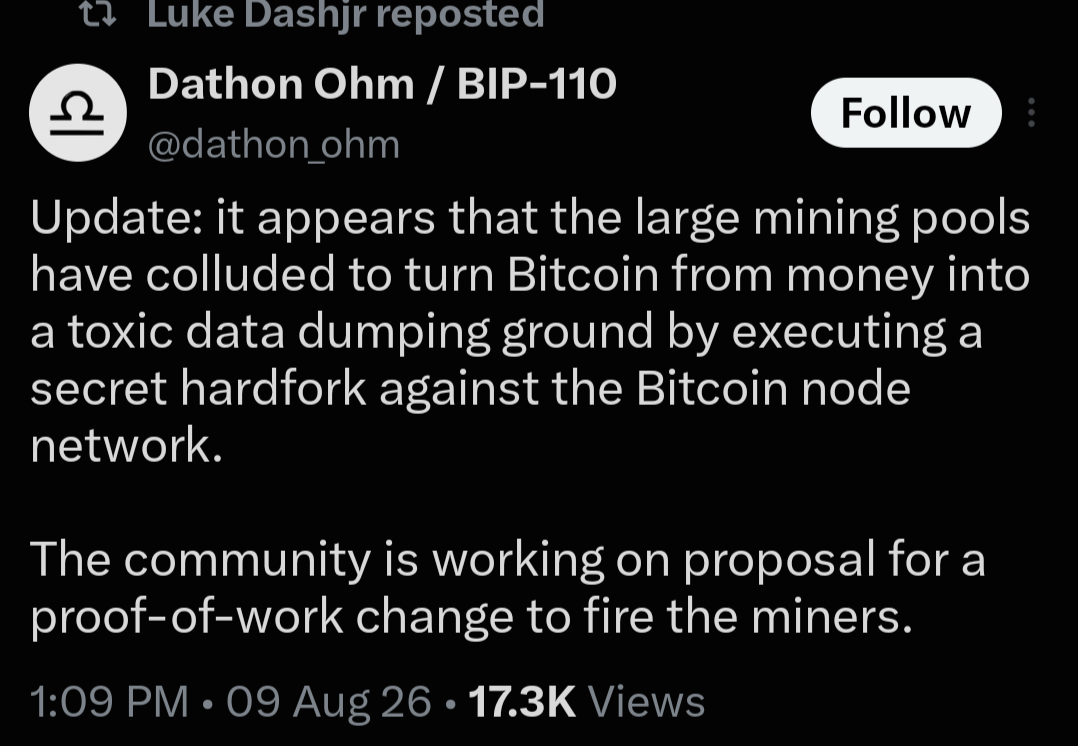 ) (likely mocking the situation) and confirms that **BIP-110—a proposed soft fork to limit non-payment data (e.g., Ordinals/Runes) in Bitcoin transactions—has mathematically failed to reach the 55% miner signaling threshold** (only ~2.6% support). Without miner backing, it cannot activate.
2. **Replay Protection Concerns**
- A user asks: *"Still no replay protection?"* This refers to a **critical risk if BIP-110 had succeeded**: a chain split could occur, and without replay protection, transactions signed on one chain (e.g., selling forked coins) could be **replayed on the other chain**, potentially draining real BTC from users’ wallets.
- Another user notes: *"Luke added that to the newest knots"*—likely meaning **Luke Dashjr (a BIP-110 contributor) added replay protection to Bitcoin Knots**, a full-node implementation, to mitigate this risk for its users.
3. **Community Reactions**
- **Opposition**: Figures like Michael Saylor, Adam Back, and Samson Mow opposed BIP-110, calling it censorship or a dangerous precedent.
- **Proponents**: Supporters (e.g., Luke Dashjr) argued it would reduce blockchain bloat from inscriptions and refocus Bitcoin on its monetary purpose.
- **Satire**: The thread includes jokes about miners "clowning" or waiting "25 years for the next difficulty adjustment" (a dig at the low support).
---
### **What Is BIP-110?**
- **Goal**: Temporarily (1 year) restrict non-payment data in Bitcoin transactions by:
- Limiting `scriptPubKey` sizes (34 bytes, except `OP_RETURN` at 83 bytes).
- Capping witness data pushes (e.g., Taproot scripts) at 256–257 bytes.
- Banning undefined witness versions, `OP_SUCCESS*`, and `OP_IF` in Tapscript.
- **Activation**: Required **55% miner signaling** (far below Bitcoin’s usual 95% threshold for consensus changes) and included a **mandatory signaling period** (blocks 961,632–963,647). If activated, it would expire after ~52,416 blocks (~1 year).
- **Controversy**:
- **Censorship concerns**: Critics saw it as an attempt to block Ordinals/Runes, which some consider legitimate use cases.
- **Replay attack risk**: Without built-in replay protection, a minority chain split could let attackers drain BTC from users who interact with the forked chain.
---
### **Why Replay Protection Matters**
- **Problem**: If a chain split occurs, a transaction signed on the minority chain (e.g., selling forked coins) could be **valid on the main chain** if the signature and inputs are identical. This could let an attacker steal real BTC.
- **Example**: You hold 1 BTC. After a split, you receive 1 "BIP-110 coin." If you sell the forked coin, the buyer could replay that transaction on the main chain, moving your real BTC to their address.
- **Solution**: Replay protection (e.g., unique signatures or chain IDs) ensures transactions on one chain are invalid on the other. **Bitcoin Knots added this**, but core Bitcoin did not.
---
---
### **Current Status (August 9, 2026)**
- **BIP-110 is dead**: It failed to reach 55% support, so **no chain split or replay risk will materialize from this proposal**.
- **Underlying debate continues**: The conflict over non-payment data (Ordinals, Runes) vs. Bitcoin’s monetary focus remains unresolved. Alternatives like **DOG Mode** (relaxing relay policies instead of consensus rules) are being discussed.
- **Lesson**: Bitcoin’s governance requires **broad consensus** (miners, nodes, economic majority). BIP-110’s failure reinforces that contentious changes face high barriers.
---
### **Key Takeaways for the User Who Asked**
1. The thread is **mocking the failed BIP-110 activation** and the drama around it.
2. **Replay protection was a major concern**—without it, a fork could have put users’ BTC at risk. Luke Dashjr added it to Bitcoin Knots to protect its users.
3. Since BIP-110 failed, **there is no immediate replay risk**, but the debate over Bitcoin’s use cases (data vs. money) is ongoing.
---
### **What Holders Should Have Done (If BIP-110 Had Activated)**
- **Avoid moving coins** during a potential split.
- **Separate balances manually** (technically complex) before transacting on either chain.
- **Use wallets/exchanges with replay protection** (e.g., Bitcoin Knots).