
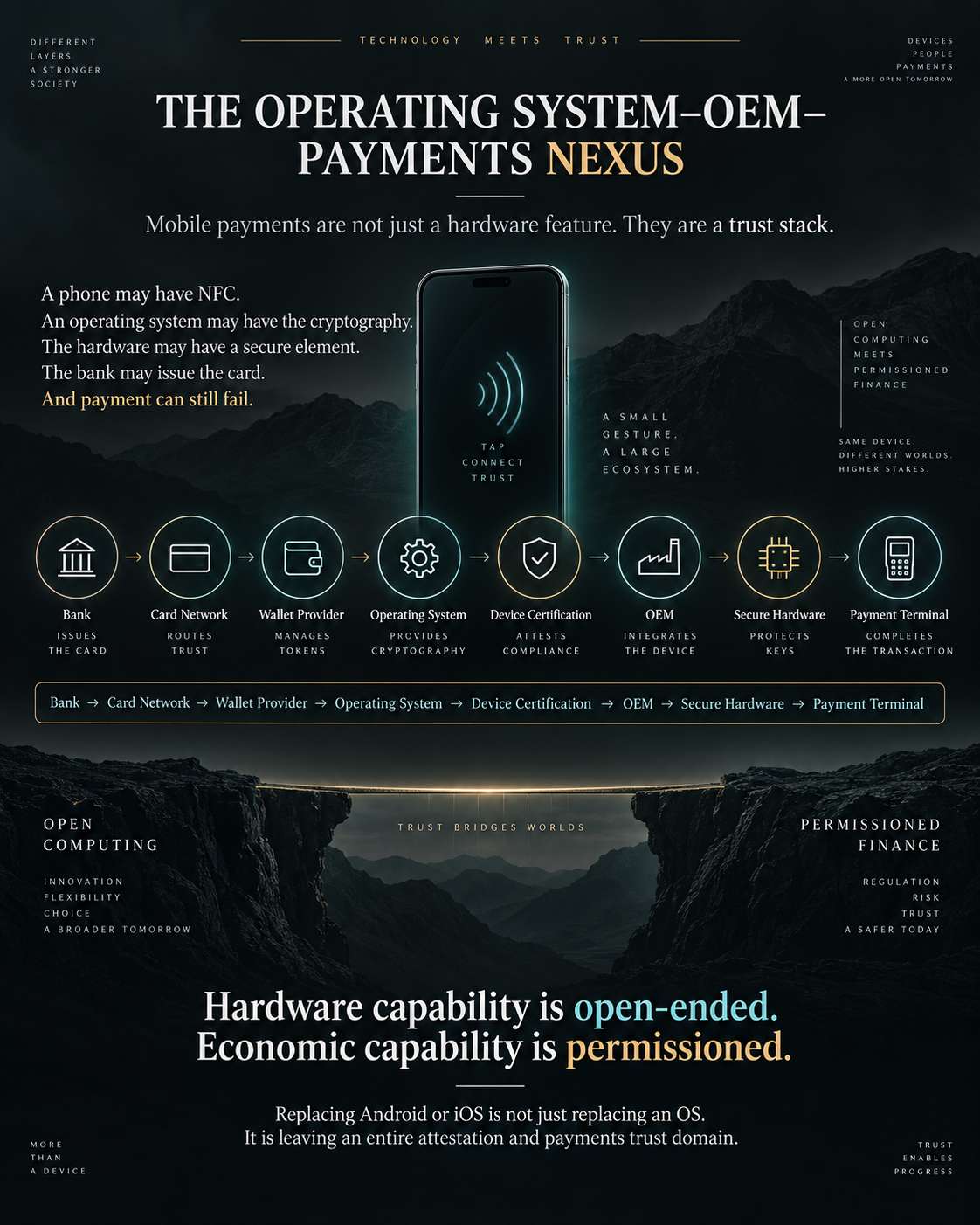
the operating system–OEM–payments nexus.
A phone may have NFC.
The operating system may have the cryptography.
The hardware may have a secure element.
The bank may issue the card.
And yet payment can still fail.
Why?
Because contactless payment is not simply a hardware capability. It is a chain of institutional trust:
Bank → card network → wallet provider → operating system → device certification → OEM → secure hardware → payment terminal
Break one link and the phone may remain perfectly capable of NFC while being excluded from the payment system.
That distinction matters.
Linux can read NFC.
Linux can sign transactions.
Linux can run hardened cryptography.
Linux can communicate with payment infrastructure.
What it generally cannot obtain by itself is the commercial attestation accepted by the incumbent payment network.
So the moat is no longer merely:
> “Can your computer perform the operation?”
It is increasingly:
> “Does the institution controlling the operation recognize your computer as legitimate?”
This is where operating-system freedom collides with financial infrastructure.
A locked-down OEM platform is valuable not only because it ships software, but because it carries a bundle of certifications, hardware identities, commercial agreements and trust relationships that independent operating systems cannot simply reproduce from source code.
That makes the smartphone payment stack a revealing example of modern platform power:
hardware capability is open-ended; economic capability is permissioned.
And it explains why replacing Android or iOS is much harder than replacing a desktop operating system.
You are not merely replacing an OS.
You are attempting to leave an entire OEM–identity–attestation–payments trust domain while continuing to participate in services built around it.
That is the real frontier for sovereign mobile computing.
#Linux #OpenSource #NFC #Payments #DigitalSovereignty #GrapheneOS #UbuntuTouch #Fintech #Cybersecurity #MobileComputing #OpenHardware #Bitcoin