
EpicyclesSome people think medieval astronomers kept adding ‘epicycles’ to the orbits of planets, culminating with the Alfonsine Tables created in 1252. The 1968 *Encyclopædia Britannica* says:
> By this time each planet had been provided with from 40 to 60 epicycles to represent after a fashion its complex movement among the stars.
But this is complete nonsense!
Medieval astronomers did *not* use so many epicycles. The [Alfonsine Tables](https://en.wikipedia.org/wiki/Alfonsine_tables ), which the *Brittanica* is mocking above, actually computed planetary orbits using the method in Ptolemy’s *Almagest*, developed way back in 150 AD. This method uses at most 31 circles and spheres—nothing like Britannica’s ridiculous claim of between 40 to 60 epicycles per planet.
The key idea in Ptolemy’s model was this:
[](
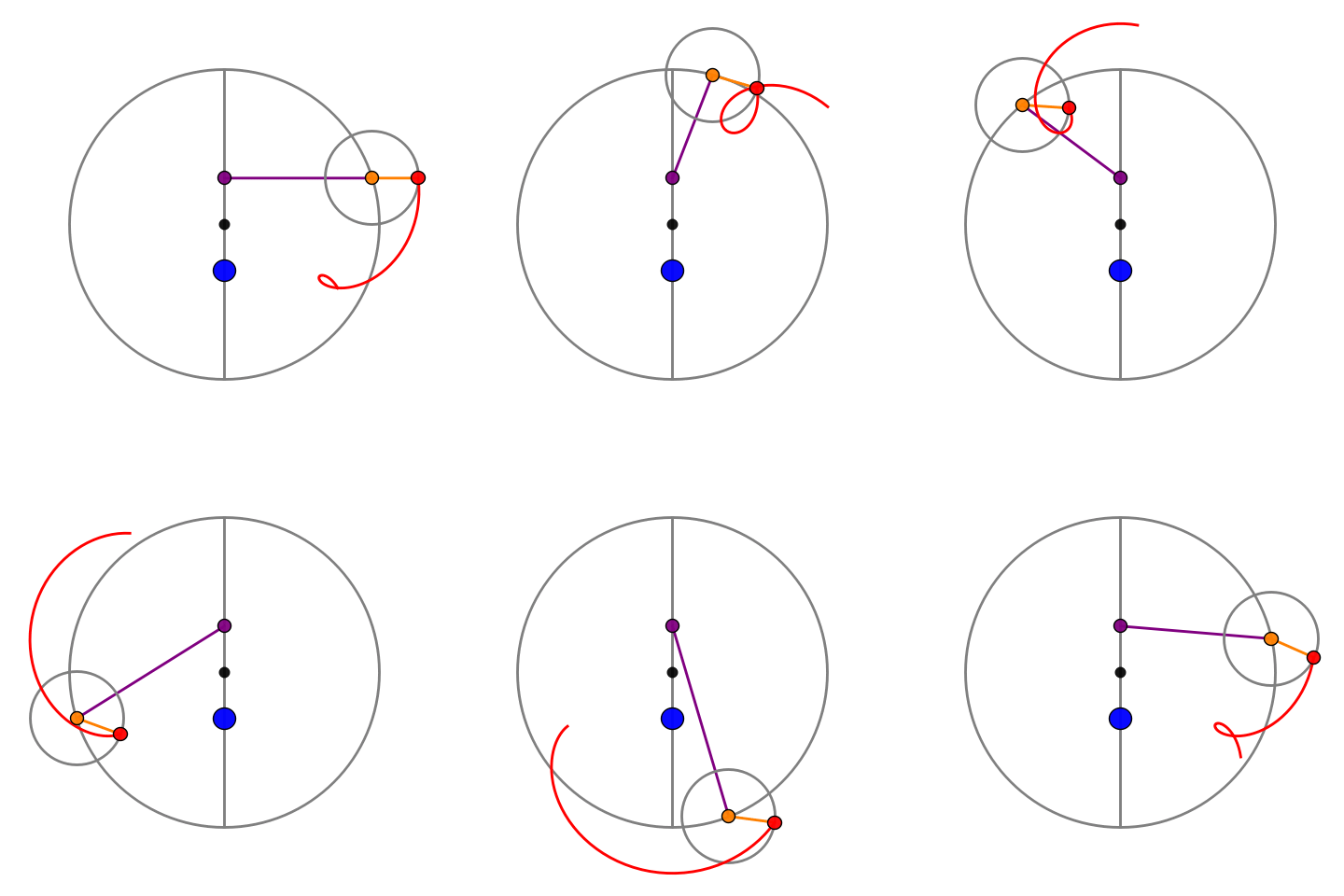 )
)The blue dot here is the Earth. The large black circle, offset from the Earth, is called a ‘deferent’. The smaller black circle is called an ‘epicycle’. The epicycle makes up for how in reality the Earth is not actually stationary, but moving around the Sun.
The center of the epicycle rotates at constant angular velocity around the purple dot, which is called the ‘equant’. The equant and the Earth are at equal distances from the center of the black circle. Meanwhile the planet, in red, moves around the center of the epicycle at constant angular velocity.
In the *Almagest*, Ptolemy used some additional cycles to account for how the latitudes of planets change over time. In reality this happens because the planets don’t all move in the same plane. Ptolemy also used additional ‘epicyclets’ to account for peculiarities in the orbits of Mercury and the Moon, and a mechanism to account for the precession of equinoxes—which really happens because the Earth’s axis is slowly precessing.
In a later work, the *Planetary Hypothesis*, Ptolemy eliminated some cycles by having the planets orbit in different planes (as they indeed do). On the other hand, he considered adding other cycles (or actually spheres) for physical purposes. Depending on how you define things, this setup either has more cycles than the *Almagest*, or a bit fewer.
Anyway, there was never a population explosion of epicycles to the wild degree that the 1968 *Brittanica* claimed. So, just because something is in an encyclopedia, or even an encyclopædia, doesn’t mean it’s true.
The Encyclopædia Britannica quote comes from their 1968 edition, volume 2, in the article on the Spanish king Alfonso X, which on page 645 discusses the Alfonsine Table commissioned by this king:
> By this time each planet had been provided with from 40 to 60 epicycles to represent after a fashion its complex movement among the stars. Amazed at the difficulty of the project, Alfonso is credited with the remark that had he been present at the Creation he might have given excellent advice.
In *The Book Nobody Read*, Owen Gingerich writes that he challenged Encyclopædia Britannica about the number of epicycles. Their response was that the original author of the entry had died and its source couldn’t be verified. Gingerich has also expressed doubts about the quotation attributed to King Alfonso X.
For the controversy over whether medieval astronomers used lots of epicycles, start here:
• Wikipedia, [Deferent and epicycle: history](https://en.wikipedia.org/wiki/Deferent_and_epicycle#History ).
and then go here:
• Wikipedia, [Deferent and epicycle: the number of epicycles](https://en.wikipedia.org/wiki/Deferent_and_epicycle#The_number_of_epicycles ).
Then dig into the sources! For example, Wikipedia says the claim that the Ptolemaic system uses about 80 circles seems to have appeared in 1898. It may have been inspired by the non-Ptolemaic system of Girolamo Fracastoro, who used either 77 or 79 orbs. So *some* theories used lots of epicycles—but not the most important theories, and nothing like the 240-360 claimed by the 1968 Brittanica.
Owen Gingerich wrote *The Book Nobody Read* about his quest to look at all 600 extant copies of Copernicus’ *De revolutionibus*. The following delightful passage was contributed by [pglpm](undrendo (npub138s…ydzl)/113653412304655853">https://mathstodon.xyz/undrendo (npub138s…ydzl)/113653412304655853 ) on Mastodon:
