Greg Egan on Nostr: From the department of very small numbers that are not zero. Suppose you want to ...
From the department of very small numbers that are not zero.
Suppose you want to approximate the gravitational field of a sphere whose density is rotationally symmetrical around some axis, but is otherwise unconstrained. You could discretise the mass within the sphere as a number of rings, centred on that axis, each of them individually having a different uniform linear density.
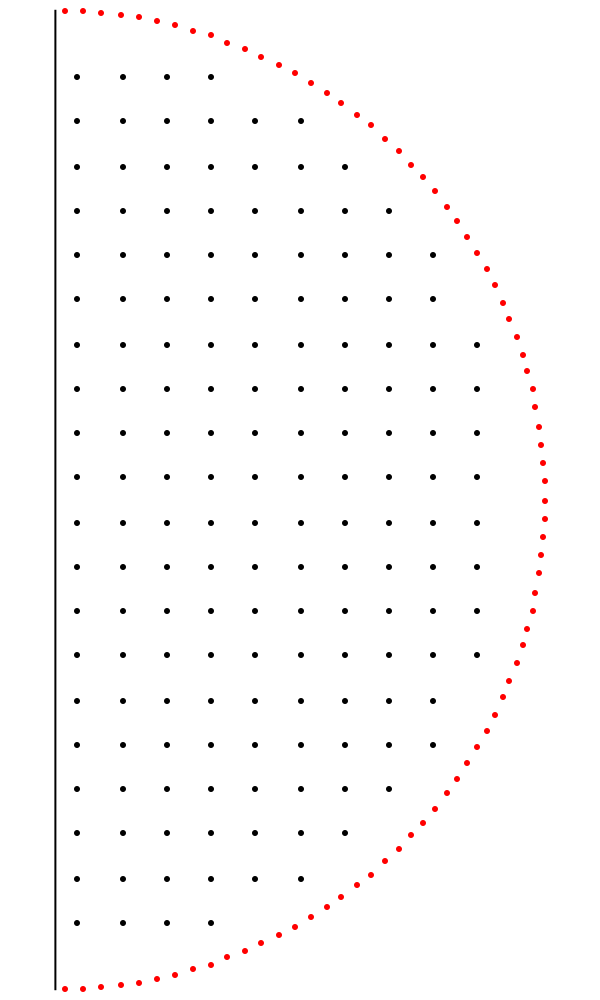
The image shows a cross-section through the sphere, with each black dot one of 166 rings. The 83 red dots are points on a meridian of the sphere where we sample the gravitational field, which we can treat as a 2-dimensional vector because it will lie precisely in the plane of the meridian.
For simplicity, assume a gravitational constant of 1, and a unit sphere. There is a linear map from the 166 densities of the rings to the 2 × 83 = 166 components of the gravitational field vectors at the 83 sample points:
T (densities vector) = gravitational field vector
What would you guess the order of magnitude of det(T) to be, if I tell you that -26.9302 ≤ 𝑇ᵢⱼ ≤ 23.9687?
Of course if T is degenerate, det(T) will be precisely zero. But why would it be degenerate?
The answer is:
det(T) ≈ -6.28 × 10⁻¹⁷⁶⁷
When I saw that, I thought: “Oh, T must be degenerate, that’s a numerical error for a true value of 0.”
But it’s not an error! It’s robust even when recomputed at very high precision.
So T is *not* degenerate.
Published at
2025-10-09 11:29:48 UTCEvent JSON
{
"id": "ea6fd40a9605ab4a845421ae4f3e6716f68ca234f02d8f784be63417282f5dcd",
"pubkey": "0037e9f1404aa866c76ed1358206ac5387eb2d3589361a3802af0f260bda26d7",
"created_at": 1760009388,
"kind": 1,
"tags": [
[
"imeta",
"url https://media.mathstodon.xyz/media_attachments/files/115/343/974/246/979/451/original/5f983d7c2d017e2f.png",
"m image/png",
"dim 600x1000",
"blurhash U3S~t|.8j[~q_3j[fQj[-VVYOrt7_3fQbHj["
],
[
"proxy",
"https://mathstodon.xyz/users/gregeganSF/statuses/115343975313330909",
"activitypub"
],
[
"client",
"Mostr",
"31990:6be38f8c63df7dbf84db7ec4a6e6fbbd8d19dca3b980efad18585c46f04b26f9:mostr",
"wss://relay.mostr.pub"
]
],
"content": "From the department of very small numbers that are not zero.\n\nSuppose you want to approximate the gravitational field of a sphere whose density is rotationally symmetrical around some axis, but is otherwise unconstrained. You could discretise the mass within the sphere as a number of rings, centred on that axis, each of them individually having a different uniform linear density.\n\nThe image shows a cross-section through the sphere, with each black dot one of 166 rings. The 83 red dots are points on a meridian of the sphere where we sample the gravitational field, which we can treat as a 2-dimensional vector because it will lie precisely in the plane of the meridian.\n\nFor simplicity, assume a gravitational constant of 1, and a unit sphere. There is a linear map from the 166 densities of the rings to the 2 × 83 = 166 components of the gravitational field vectors at the 83 sample points:\n\nT (densities vector) = gravitational field vector\n\nWhat would you guess the order of magnitude of det(T) to be, if I tell you that -26.9302 ≤ 𝑇ᵢⱼ ≤ 23.9687?\n\nOf course if T is degenerate, det(T) will be precisely zero. But why would it be degenerate?\n\nThe answer is:\n\ndet(T) ≈ -6.28 × 10⁻¹⁷⁶⁷ \n\nWhen I saw that, I thought: “Oh, T must be degenerate, that’s a numerical error for a true value of 0.”\n\nBut it’s not an error! It’s robust even when recomputed at very high precision.\n\nSo T is *not* degenerate.\n\nhttps://media.mathstodon.xyz/media_attachments/files/115/343/974/246/979/451/original/5f983d7c2d017e2f.png",
"sig": "09fe8db009d8369967de61ff6d1051a7b5b956a89ba1cac731efbec2889ed8f7022b578d0759ab362d4ff2d5bd949e58088ff215538650200947505b2e8db21c"
}