129.746338
which is a bit more than
2⁷ = 128
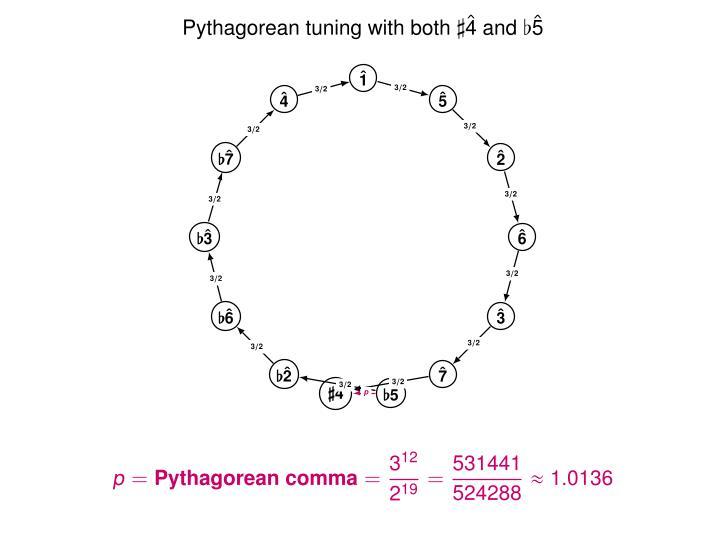
The ratio of these two is called the 'Pythagorean comma':
p = (3/2)^12 / 2⁷ = 3¹² / 2¹⁹ ≈ 1.0136
This is like an unavoidable lump in the carpet when you use Pythagorean tuning.
It's good to stick the lump in your carpet under your couch. And it's good to stick the Pythagorean comma in the so-called 'tritone' - a very dissonant note that you'd tend to avoid in medieval music. This note is ♭5, which is the same as ♯4. It's halfway around the circle of notes and it's also halfway around the circle of fifths. In equal temperament its frequency is √2 times that of your starting note.
In equal temperament, you get the tritone by going either 6 steps up the circle of fifths or 6 steps down. In Pythagorean tuning, going 6 steps up the circle of fifths doesn't give you the same note as going 6 steps down! We call one of them ♭5 and the other ♯4. Their frequency ratio is the Pythagorean comma.
(16/n)