John Carlos Baez on Nostr: In 2025, researchers studied a quasicrystal forged in a hypervelocity asteroid impact ...
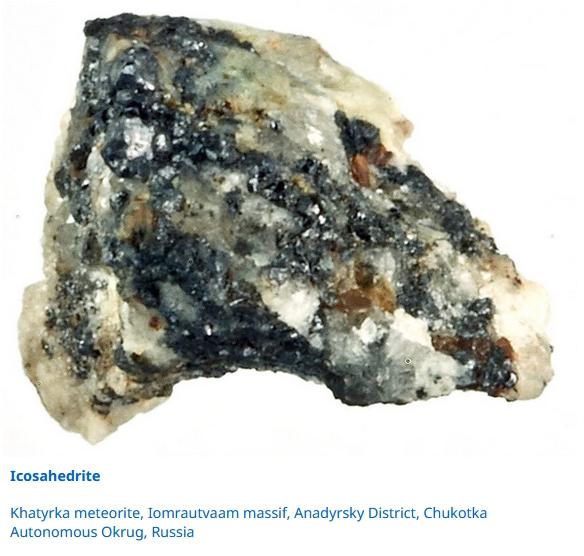
In 2025, researchers studied a quasicrystal forged in a hypervelocity asteroid impact event roughly 4.5 billion years ago in the early solar system - and found that it contains 'phasons'!
It's not a perfect icosahedral quasicrystal: it's slightly distorted! 6 gentle 'phason waves' run through it, oriented along the 6 fivefold symmetry axes of an icosahedron. These waves were locked in when the alloy quickly cooled after impact, and they've been sitting there frozen in the structure ever since.
This quasicrystal is called 'icosahedrite'. The easiest way to describe it is the 'slice and project' method. You start with a lattice in 6 dimensions, choose a 3d slice, thicken that up a bit, take the lattice points that lie in this slice, and project them down to 3d space. The atoms in the icosahedrite are exactly the projections of the 6d lattice points that happen to fall inside the thickened slice.
But now imagine wobbling the slice gently - not tilting it, but wiggling it sideways in the other three dimensions, the ones perpendicular to physical space. Some 6d lattice points slip out of the slice and others slip in. In physical space this looks like atoms suddenly hopping from one position to a nearby alternative one.
These atomic hops are called 'phason flips', and a wave of them is a 'phason'. Sound waves involve atoms swaying smoothly in place; phasons involve atoms jumping between alternative positions, and they exist only in quasicrystals.
These phasons are a fossil record of the collision that made the quasicrystal: the instant of cooling, preserved as a piece of warped 6-dimensional geometry, sitting inside a rock for 4.5 billion years!
Published at
2026-05-15 09:24:40 UTCEvent JSON
{
"id": "07035b3c62c366b246b8dd86648b4d1a38c2c527489d968525221bbd5dbdef24",
"pubkey": "9a6a1a8eefd0b53d7e0c966ab35bd904151246f03b1be98fa0d2d0eeb4940320",
"created_at": 1778837080,
"kind": 1,
"tags": [
[
"proxy",
"https://mathstodon.xyz/@johncarlosbaez/116577866883794595",
"web"
],
[
"imeta",
"url https://media.mathstodon.xyz/media_attachments/files/116/577/860/662/931/615/original/cee6694d3cfad503.jpg",
"m image/jpeg"
],
[
"proxy",
"https://mathstodon.xyz/users/johncarlosbaez/statuses/116577866883794595",
"activitypub"
],
[
"L",
"pink.momostr"
],
[
"l",
"pink.momostr.activitypub:https://mathstodon.xyz/users/johncarlosbaez/statuses/116577866883794595",
"pink.momostr"
],
[
"-"
]
],
"content": "In 2025, researchers studied a quasicrystal forged in a hypervelocity asteroid impact event roughly 4.5 billion years ago in the early solar system - and found that it contains 'phasons'! \n\nIt's not a perfect icosahedral quasicrystal: it's slightly distorted! 6 gentle 'phason waves' run through it, oriented along the 6 fivefold symmetry axes of an icosahedron. These waves were locked in when the alloy quickly cooled after impact, and they've been sitting there frozen in the structure ever since.\n\nThis quasicrystal is called 'icosahedrite'. The easiest way to describe it is the 'slice and project' method. You start with a lattice in 6 dimensions, choose a 3d slice, thicken that up a bit, take the lattice points that lie in this slice, and project them down to 3d space. The atoms in the icosahedrite are exactly the projections of the 6d lattice points that happen to fall inside the thickened slice.\n\nBut now imagine wobbling the slice gently - not tilting it, but wiggling it sideways in the other three dimensions, the ones perpendicular to physical space. Some 6d lattice points slip out of the slice and others slip in. In physical space this looks like atoms suddenly hopping from one position to a nearby alternative one.\n\nThese atomic hops are called 'phason flips', and a wave of them is a 'phason'. Sound waves involve atoms swaying smoothly in place; phasons involve atoms jumping between alternative positions, and they exist only in quasicrystals.\n\nThese phasons are a fossil record of the collision that made the quasicrystal: the instant of cooling, preserved as a piece of warped 6-dimensional geometry, sitting inside a rock for 4.5 billion years!\nhttps://media.mathstodon.xyz/media_attachments/files/116/577/860/662/931/615/original/cee6694d3cfad503.jpg\n",
"sig": "d6e9ee64819e812fe3a7c845dc8b5e68d57ef002bcf1a703efa64cfdb1d7bd48c50f2a09229ad2686d518014c257e7e39b84d23e4b95d97f71828b6bb1a39992"
}