APOD on Nostr: **Astronomy Picture of the Day** 16 September 2024 **Mercury's Vivaldi Crater from ...
**Astronomy Picture of the Day**
16 September 2024
**Mercury's Vivaldi Crater from BepiColombo**
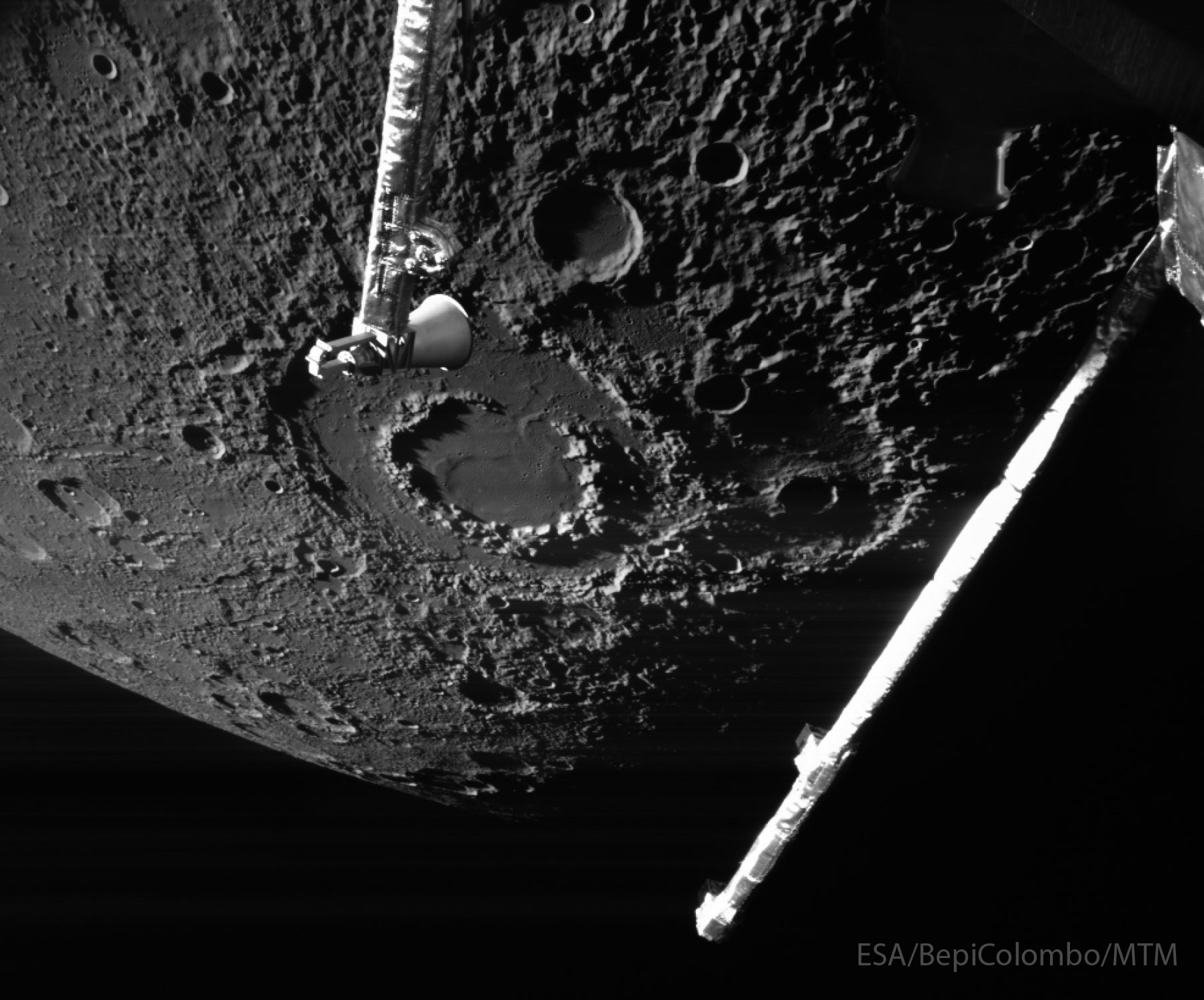
*Image creditor details unavailable via API. Visit linked page below for full info.*
Why does this large crater on Mercury have two rings and a smooth floor? No one is sure. The unusual feature called Vivaldi Crater spans 215 kilometers and was imaged again in great detail by ESA's and JAXA's robotic BepiColombo spacecraft on a flyby earlier this month. A large circular feature on a rocky planet or moon is usually caused by either an impact by a small asteroid or a comet fragment, or a volcanic eruption. In the case of Vivaldi, it is possible that both occurred -- a heavy strike that caused a smooth internal lava flow. Double-ringed craters are rare, and the cause of the inner rings remains a topic of research. The speed-slowing gravity-assisted flyby of Mercury by BepiColombo was in preparation for the spacecraft entering orbit around the Solar System's innermost planet in 2026.
#APOD #Astrogeology #Galactic #Universe #SpaceStation
https://apod.nasa.gov/apod/ap240916.htmlPublished at
2024-09-16 04:09:25 UTCEvent JSON
{
"id": "0e5fcc0c14dbf910e0dfdf5d41ad4208012a224a6c15637c0137a2d679ef7914",
"pubkey": "e85ed75286cb77475776c1007df8c4ff1c9c68eff91c3627347b065c5bf4dc78",
"created_at": 1726459765,
"kind": 1,
"tags": [],
"content": "**Astronomy Picture of the Day**\n\n16 September 2024\n\n**Mercury's Vivaldi Crater from BepiColombo**\n\nhttps://apod.nasa.gov/apod/image/2409/MercuryCaloris_BepiColombo_1806.jpg\n\n*Image creditor details unavailable via API. Visit linked page below for full info.*\n\nWhy does this large crater on Mercury have two rings and a smooth floor? No one is sure. The unusual feature called Vivaldi Crater spans 215 kilometers and was imaged again in great detail by ESA's and JAXA's robotic BepiColombo spacecraft on a flyby earlier this month. A large circular feature on a rocky planet or moon is usually caused by either an impact by a small asteroid or a comet fragment, or a volcanic eruption. In the case of Vivaldi, it is possible that both occurred -- a heavy strike that caused a smooth internal lava flow. Double-ringed craters are rare, and the cause of the inner rings remains a topic of research. The speed-slowing gravity-assisted flyby of Mercury by BepiColombo was in preparation for the spacecraft entering orbit around the Solar System's innermost planet in 2026.\n\n#APOD #Astrogeology #Galactic #Universe #SpaceStation\n\nhttps://apod.nasa.gov/apod/ap240916.html\n",
"sig": "c649bf89c8f4adf87be5d7fd7142060a2c3a9fb65d8c0151efc016092e9fbc489dfbba2e508fc5f819af4205fef2d4d73e892fdc14da735cede3c2ea2bbe48bf"
}
