The premise is always the same:
Solar panels are extremely cheap for the power. Even if you live somewhere windy or with a river, there's often nothing out there that's cheaper per kWh per year. However, solar is pretty seasonal, if you install enough solar that you will *almost* never need grid or generator power - which BTW is pretty cheap to do - you will end up with SO MUCH over-generation in sunny summer months that you will want to find something to do with the extra energy. Ideally store it for dark winter months.
I don't really have anything new today, but I have a correction to my battery post I made last week. When I was mathing out the power generation, I forgot that these batteries make hydrogen.
Not just incidental hydrogen, but hydrogen as a fundamental part of the battery reaction.
This reaction LOOKS balanced:
FeCl₂ + 2NaOH → Fe(OH)₂ + 2NaCl
But the structure of the cell shows you that it is not:
+| Fe(OH)₂ |CEM| FeCl₂ |AEM| NaCl |CEM| NaOH |-
The CEMs are cation exchange membranes which allow + ions (Fe+ and Na+) to pass, the AEMs are anion exchange membrane which allows - ions (Cl-) to pass. The flow is as follows:
Charging: +| Fe(OH)₂ |Fe+->| FeCl₂ |<-Cl-| NaCl |Na+->| NaOH |-
Discharging: +| Fe(OH)₂ |<-Fe+| FeCl₂ |Cl- ->| NaCl |<-Na+| NaOH |-
The CEMs are cation exchange membranes, the lefthand one allows passage of Fe+ only while the righthand one allows passage of Na+ only.
The problem should not be pretty clear, when discharging, you make Fe(OH)₂ in the left-most sub-cell and you consume NaOH in the right-most sub-cell. When charging it is the opposite. Even though the total OH doesn't change, you're still making and destroying it in different places. So this cell will make hydrogen gas while charging and while discharging.
And unfortunately, the cost of splitting H₂O is high enough that energy input is needed during both charge and "discharge" phases, it's just that 1/3 less energy is needed in discharge (for the same H2 output).
---
Likewise, the NaCl -> HCl + NaOH cell suffers the same problem. In order to make HCl, you need to pry an H+ off of a water molecule, creating O₂ as the remaining H₂O shuffles the remaining hydrogens and oxygens.
And on the other side, making NaOH requires prying an OH off of an H₂O making an H₂ from each pair of H₂O. This again ruins the energy storage of the battery and reduces it to a H₂ cell with "high consumption mode" and "low consumption mode".
---
There are three potential solutions to this problem:
1. Actually use the water-split reaction for the energy storage - this is attractive because there's a lot of energy wrapped up in a liter of water. Unfortunately unless we find a hydrogen carrier, we end up back at the H2 storage problem that has been discussed ad nausium.
2. Try to make a battery that emits hydrogen as its discharge mechanism. If you make HCL and then pour it in solid iron, you get H2 and FeCl2, which can then be made into more HCl and solid iron later. So when you charge, you store HCl and solid iron, and when you discharge you store FeCl2. This is potentially an interesting way to "store" hydrogen.
3. Eliminate the H+ and OH- component from the battery.
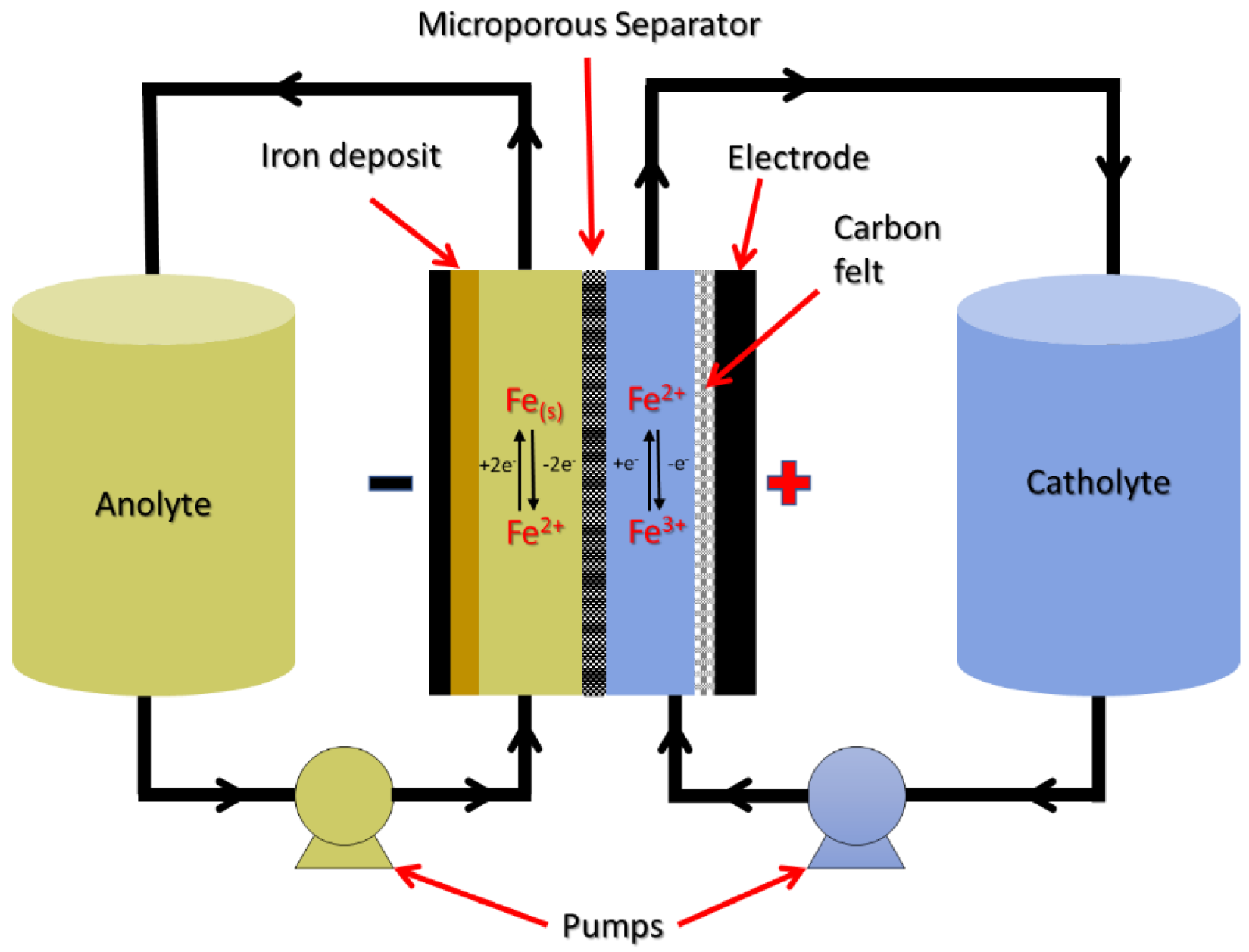
A nice example of #3 is the classical iron chloride flow battery:
Fe(solid) + 2FeCl₃ -> 3FeCl₂
In the charged state, you have FeCl₃ + iron solid, and discharging is pulling iron off of the solid iron into FeCl₂ and pulling the chloride out of FeCl₃. This battery has about 76 watt-hours per liter of electrolyte, so a cubic meter gives you 76 kWh. FeCl₃ is fairly acidic, and if you don't keep it acidic you start to get Fe(OH)₃ evolution and lose your chlorine to the air. However, in realistic applications, it will be about equivalent to 0.5% HCl, less concentrated than the acid found in typical lead-acid car batteries. So much more practical than carrying around 33% HCl.
RT: https://pkteerium.xyz/objects/e1e4cfe1-3328-40c4-ad83-38c635ec66d0