Take a regular pentagon and draw it in the unit circle with one vertex at (1,0). Write down formulas for the vertices and the edges, which we can think of as points and lines. Now replace √5 by −√5 in all these formulas. You get a pentagram!
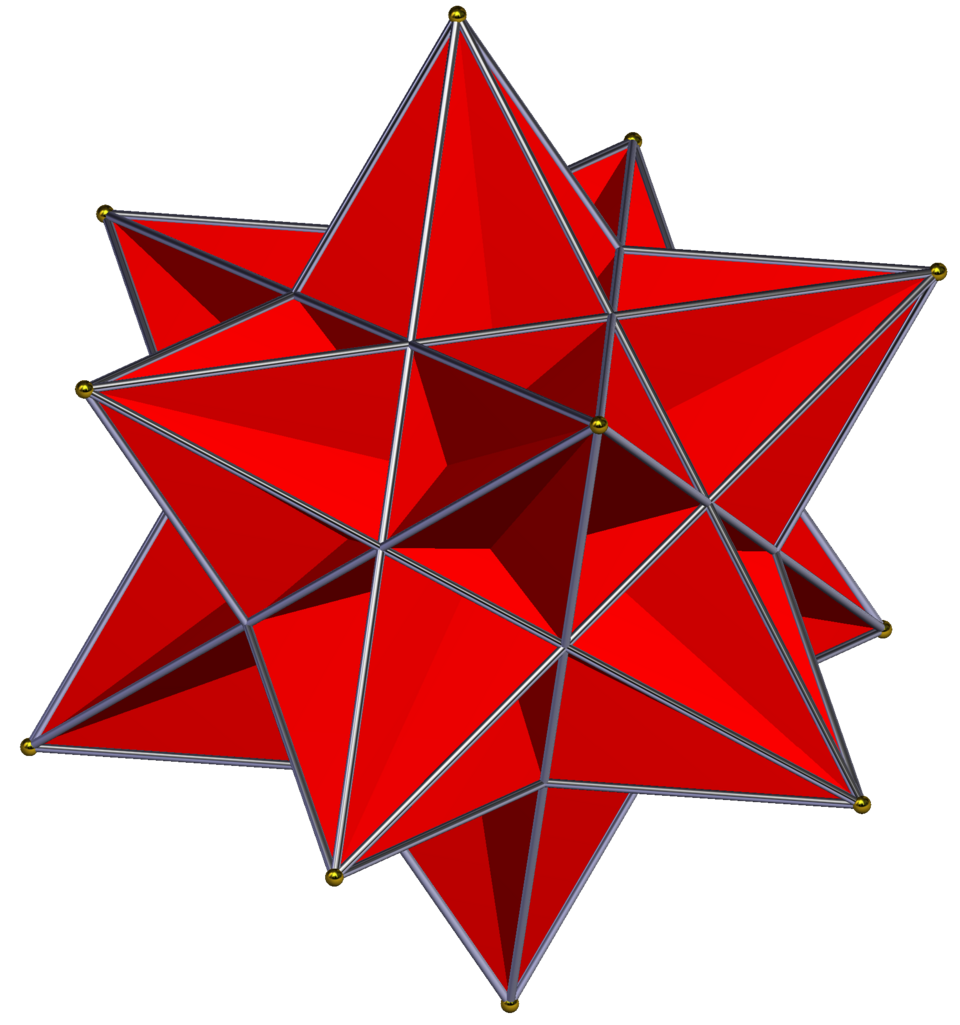
QUESTION. If you apply the same trick to the icosahedron, do you get the great icosahedron?
That is: can you write down equations for the vertices, edges and faces of a regular icosahedron in some nice coordinate system, and then replace √5 by −√5 in all these equations, and get a great icosahedron???
I just don't have time for this today. 😢
If you want to try it, here are some nice coordinates for the vertices of the icosahedron, to get you going:
(±1,±Φ,0), (0,±1,±Φ), (±Φ,0,±1)
The signs are chosen independently, so we get a total of 12 vertices. Φ = (1 + √5)/2 is the golden ratio.
Another hint: the vertices of the great icosahedron are also vertices of a regular icosahedron. You just need to connect them in a different way.
Notice that if we take the 12 vertices above and replace √5 by -√5 we do get the vertices of a regular icosahedron - a smaller one. So that's good. Then it's just a matter of keeping track which ones are connected to which others by edges.