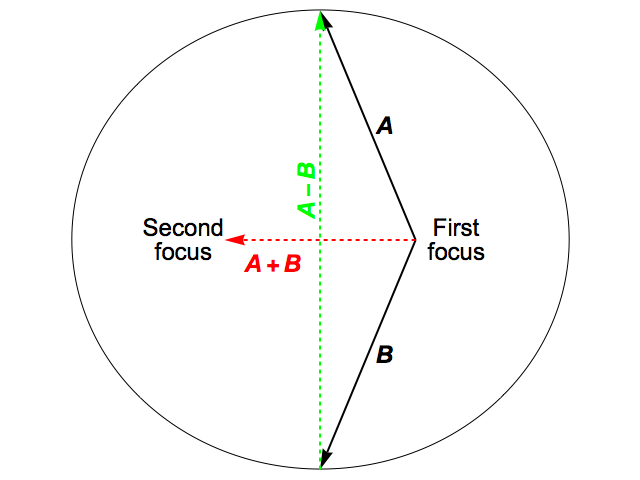
Choose two vectors A and B whose lengths are equal. Place one focus of an ellipse at the origin, place the second focus at A + B, and position the two points of the ellipse where the tangent to the curve is parallel to its axis at A and B. This construction will always yield an ellipse with a semi-major axis equal to |A| (with the degenerate case of a line when A = B), and the entire family of ellipses with one focus at the origin and the same length for the semi-major axis can be generated by rotating A and B independently.
The total energy of a Newtonian orbit like this depends *only* on the semi-major axis of the ellipse, so what this tells us is that there are *two* three-dimensional rotations that we can perform while still yielding an orbit with the same energy. And the set of all rotations of *four*-dimensional space correspond to *pairs* of three-dimensional rotations.
For much, much more on all this:
https://www.gregegan.net/SCIENCE/Ellipse/Ellipse.html
and a beautiful series of blog posts by John Carlos Baez (npub1nf4…nqe4)
https://johncarlosbaez.wordpress.com/2025/07/14/the-kepler-problem-part-2/