Lets define
\[
\begin{split}
x = \sum_i x_{oi}\otimes x_{ci}\\
y = \sum_i y_{oi}\otimes y_{ci}
\end{split}
\]
with \(x_{oi}\in\mathbb{O}\) and likewise for \(y_{oi}\) and \(x_{ci}\in\mathbb{C}\) and likewise for \(y_{ci}\). Then, writing out \((xx^*)y\) becomes
\[
\begin{split}
(xx^*)y=\sum_{ijk}((x_{oi}x_{oj}^*)y_{ok})\otimes x_{ci}x_{cj}^*y_{ck}\\
= \sum_{ijk}[x_{oi},x_{oj}^*,y_{ok}]\otimes x_{ci}x_{cj}^*y_{ck} + \\
+ \sum_{ijk}(x_{oi}(x_{oj}^*y_{ok}))\otimes x_{ci}x_{cj}^*y_{ck}
\end{split}
\]
where we used the associator \([a,b,c]=(ab)c-a(bc)\). Thus, when the term with the associator can be made not to vanish we've found a counter example.
Lets use
\[
\begin{split}
[e_1,e_2,e_3]=-2e_6\\
[e_2,e_1,e_3]=2e_6
\end{split}
\]
together with the fact that \([x_{oi},x_{oj}^*,y_{ok}]\) is zero on the \(i=j\) diagonal.
Note, that in the pure octonionic case (i.e. all the \(\mathbb{C}\) variables are real) the term with the associator vanishes, although the associator is non-zero on the \(i\neq j\) off-diagonal. Thus, the reality of the complex coefficients is crucial for the vanishing of that term and we found the last hint how to break it using \(\mathbb{C}\). Thus, we can guess the counter example
\[
\begin{split}
x=e_1\otimes 1 + e_2\otimes i \\
y=e_3
\end{split}
\]
Checking
\[
\begin{split}
(xx^*)y=2e_3\otimes 1+2e_6\otimes i\\
\neq x(x^*y)=2e_3\otimes1 - 2 e_6\otimes i
\end{split}
\]
(Based on the convention
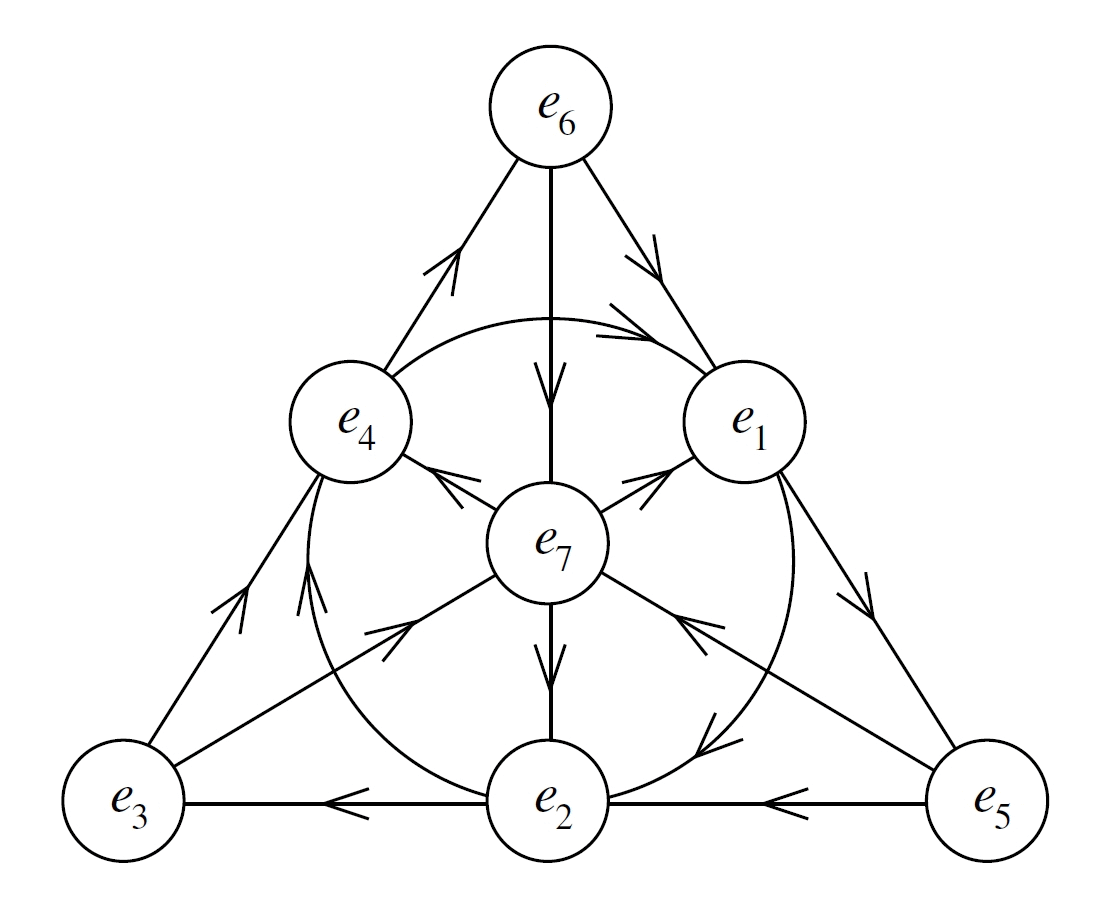 )
)