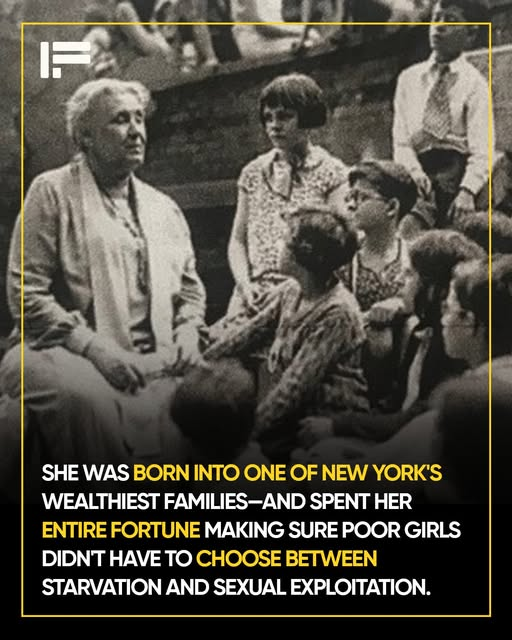
"She was born into one of the richest families in New York.
Instead of living in luxury, she spent her life trying to make sure poor girls would never have to sell their bodies just to survive.
In the 1880s, Grace Hoadley Dodge was a young woman living a life most people could only imagine. Her family belonged to the powerful Dodge dynasty—industrial wealth tied to railroads, business, and New York’s elite social circles during the era historians call the Gilded Age.
Her home stood along Manhattan’s prestigious Madison Avenue. Society expected her to follow a predictable path: marry well, host elegant dinners, attend charity events, and live comfortably among the city’s wealthiest families.
But Grace’s life took a very different direction.
At twenty-four years old, she began volunteering as a Sunday school teacher for working-class girls living in New York’s crowded tenement neighborhoods.
She thought she would be teaching scripture.
Instead, the girls taught her something far more disturbing about how the city actually worked.
Many of them were barely teenagers. Some were only twelve years old. They worked long shifts in factories, garment workshops, and laundries that stretched twelve hours or more each day. Their weekly wages often hovered around three dollars.
Rent for a small room could easily cost two dollars a week.
That left only one dollar for everything else: food, clothing, medicine, and survival.
Grace quickly realized the arithmetic of poverty created brutal choices.
Some girls went hungry.
Others accepted “favors” demanded by factory foremen who controlled work schedules and wages.
Some turned to prostitution—not out of desire, but because it was the only way to avoid starvation.
Many simply disappeared into the vast anonymity of New York’s streets.
Grace had been sent there to teach morality.
Instead, she began asking a question that challenged the assumptions of her time.
What if the problem wasn’t the girls themselves?
What if the real problem was a society that left them with no safe options?
That realization transformed her life.
Grace understood she possessed something the girls did not—resources, influence, and connections within powerful social circles.
Rather than treating poverty as a charity project, she began building something far more ambitious.
Infrastructure.
In 1884, she helped establish the Kitchen Garden Association, an early effort to teach young women practical skills that could help them support themselves. Initially the focus was domestic training such as cooking and household management.
But Grace soon recognized that domestic work alone would not free women from exploitation.
So she shifted her strategy.
She began advocating for vocational education—training that would allow women to enter skilled professions. Bookkeeping, stenography, office work, and other emerging fields offered higher wages and safer conditions than factory labor.
The idea was controversial.
Many people believed working-class women should remain in domestic service or manual labor. Factory owners benefited from a constant supply of poorly paid workers. Even some reformers worried that education might make working-class women unwilling to accept traditional roles.
Grace ignored the criticism.
She believed education created independence.
A woman who understood accounting could work in an office instead of a sweatshop. A woman trained in stenography could secure employment that did not depend on the approval of abusive supervisors.
Education meant leverage.
In 1887, Grace helped found one of the most influential educational institutions in the United States: Teachers College Columbia University.
At the time, teaching was not widely considered a professional career. Many teachers received little formal training and earned extremely low wages.
Grace envisioned something different.
Teachers College would provide rigorous training for educators, transforming teaching into a respected profession. The institution quickly grew into a major center for educational research and teacher preparation.
More than a century later, it still trains thousands of educators every year.
But Grace’s work extended far beyond education.
In 1906 she helped establish the national leadership structure of the Young Women's Christian Association.
Under her influence, the YWCA expanded beyond religious meetings into practical support for working women. The organization developed safe boarding houses where young women arriving in cities could live without exploitation by predatory landlords.
It offered evening classes that taught job skills.
It helped women find legitimate employment.
It created networks where women could share information about safe workplaces and dangerous employers."
https://digitalcommons.molloy.edu/hps_fac/3/
#RadicalFeminism #RadFem #Feminism #Feminist #WomensHealth #WomynsHerstory #WomensHistoryMonth #WomensHistoryMonth2026 #AbolishProstitution #NotSexNotWork