Event JSON
{
"id": "de68432ceb3d0dea7fed3e78e331741aac4ea0354cc4b705620eb188d5273e68",
"pubkey": "bb64e9640a7b81f1eb812a62963f4fe6760da5f7ec94fa33fbd76c00c8ad238f",
"created_at": 1749323723,
"kind": 1,
"tags": [
[
"imeta",
"url https://files.mastodon.social/media_attachments/files/114/643/674/054/128/125/original/27439e355776b953.png",
"m image/png"
],
[
"t",
"logic"
],
[
"proxy",
"https://mastodon.social/@rzeta0/114643679539810026",
"web"
],
[
"t",
"maths"
],
[
"t",
"cs"
],
[
"proxy",
"https://mastodon.social/users/rzeta0/statuses/114643679539810026",
"activitypub"
],
[
"L",
"pink.momostr"
],
[
"l",
"pink.momostr.activitypub:https://mastodon.social/users/rzeta0/statuses/114643679539810026",
"pink.momostr"
],
[
"-"
]
],
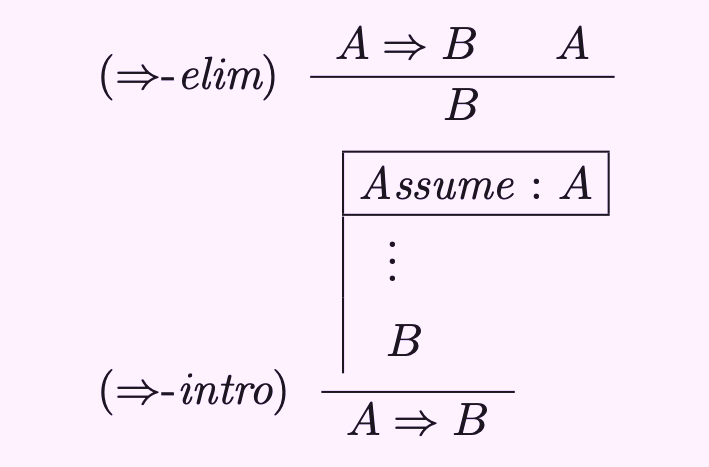
"content": "Need some help.\n\n-----\n\nI know that to prove P ⇒ Q, I assume P and derive Q.\n\n----\n\nNow to prove\n\n(A⇒B) ⇒ ((B⇒C) ⇒ (A⇒C))\n\nI need to assume (A⇒B) and derive ((B⇒C) ⇒ (A⇒C)).\n\nBut I can't seem to make progress from (A⇒B) alone, I think I need to assume A is true as well.\n\n----\n\nIntuitively the statement makes total sense. But drawing the derivation as per image attached using elim and intro rules, I get stuck unless I assume A too.\n\nCan anyone help clarify my thinking?\n\n#maths #cs #logic\nhttps://files.mastodon.social/media_attachments/files/114/643/674/054/128/125/original/27439e355776b953.png\n",
"sig": "7e959be0800d87e247cc6835aa068489be53429a7a9c909abe09179645994d8a2bb58515660353726dd71232afde847555b4f28733e7d23702be98c9d045625b"
}