
quotingNobody Understands Leyden Jars.
nevent1q…v8p5
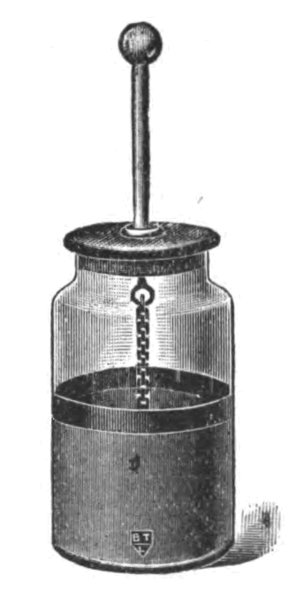
A leyden jar, for those who have never seen one, is a rudimentary capacitor made from a jar and some metal foil. In the early days of electricity research, they were commonly used for storing static electricity.
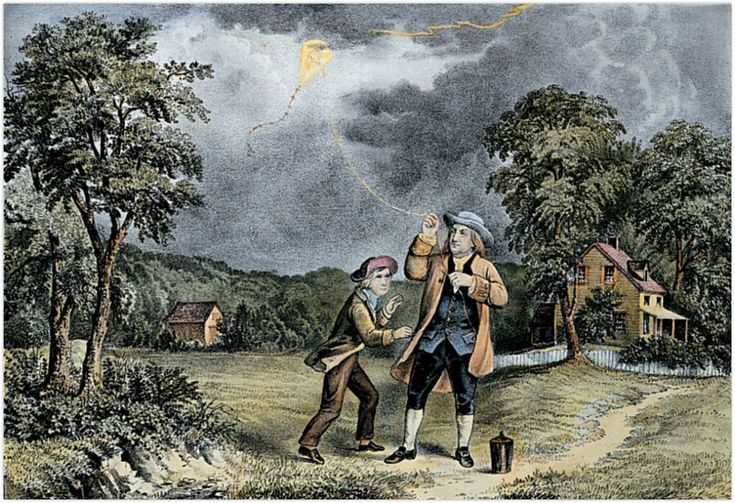
In the famous Ben Franklin kite experiment, he was said to have stored the static collected from the air to a leyden jar.
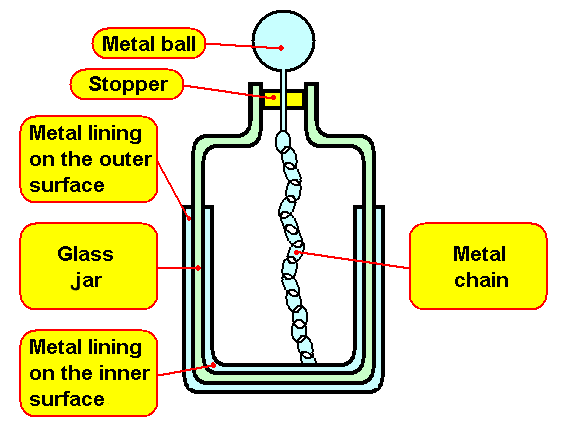
Normally, they're pretty simple devices, they have 2 conductive plates (foil) separated by an insulator (glass), that's your classical capacitor. What makes absolutely no sense is the fact that when you fill one with water, it's capacity for storing energy increases *dramatically*.
Based on typical electrical understanding, this is a total mystery. The water is not completing a circuit that goes anywhere, it's not even acting as an electrode because (as you can see in diagram 2) there is foil between the water and the glass. The water seems to be connected to a dead-end of the circuit.
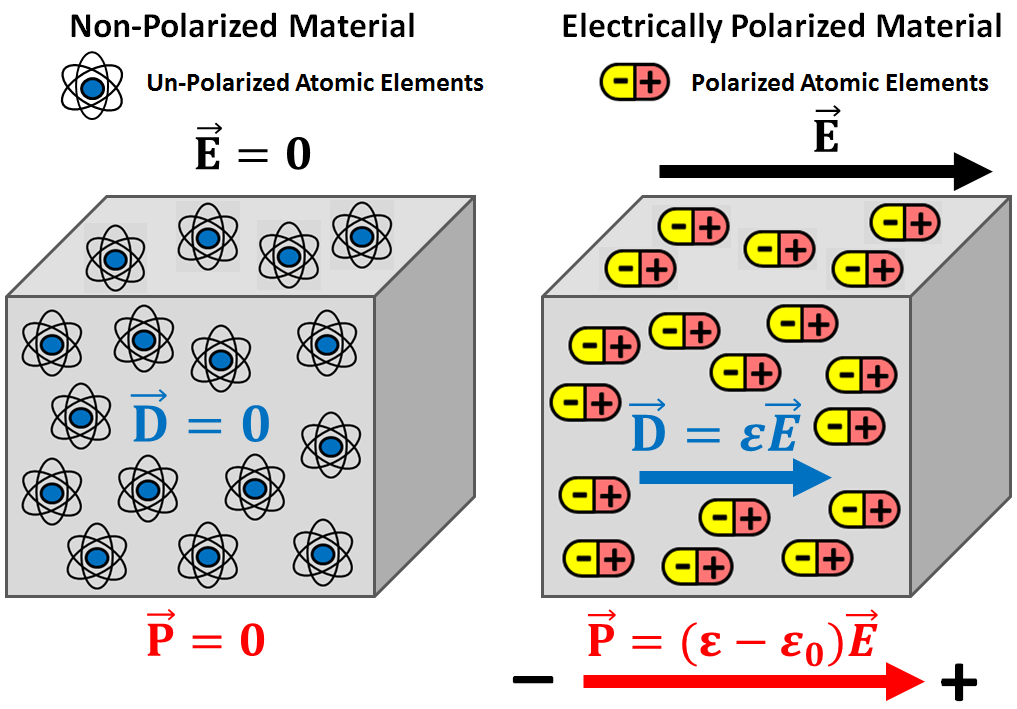
The reason why water affects the leyden jar is because electric fields cause water to polarize (fig 4). All of the hydrogens begin pointing one way, and all of the oxygens begin pointing the other. The water doesn't "want" to do this, entropy drives it toward random alignment. Polarization actually causes a small amount of heat to be expelled from the water, and relaxation (discharging the jar) causes a small amount of heat to be absorbed as the atoms go back to bouncing around at random, this is called electrocaloric effect.
This is one thing, and it explains why water has such an effect on leyden jars, but when there's an electrolyte like salt in the water, things get even more interesting.
Common table salt is NaCl (sodium chloride). Dissolved in water, we're told, the Na+ and Cl- disassociate. Though they're no longer chemically bonded, they have opposite charges so they don't move far apart from each other. In classical electrolysis, you apply electricity across two plates, pulling the Na+ in one direction and the Cl- in the other. Then electrons split H2O into H2 and OH-. Were it not for the Na+, the entire reaction would stop before you noticed anything, but because Na+ is happy to sit next to OH-, Cl- is free to walk across the cell to the other side, where electricity does one of two things: Either evolve Cl2 (chlorine gas) or else O2.
Now this little detour into electrolysis is important because the first step in this process is actually happening in a leyden jar. If you have a salt water leyden jar, and you charge the outer plate negative (water is positive), the Na+ is drawn toward the outer edge of the jar while the center of the jar becomes Cl- rich. If you charge the jar and then draw water from the center, you will get Cl- rich water. If you then discard the remaining water and put back the Cl- rich water and charge it again, you will get even richer water.
You can easily imagine a cascade of this construct making arbitrarily strong NaOH (sodium hydroxide) and HCL (hydrochloric acid) simply by doing the same bias over and over again. Indeed a 2020 paper ( https://www.sciencedirect.com/science/article/abs/pii/S0011916419312937 ) showed that exactly this trick can be used for desalination of sea water - because as the NaOH and HCL become more concentrated, the intermediate water obviously becomes less salty.
But what's really interesting is that this isn't constrained to Na+Cl- ions, ALL ions in water would be drawn out by this cascading construct (including fluoride), so it could be used as an alternative to reverse osmosis filtration.
But even fresh distilled, deionized water has ions. These are "intrinsic" ions of H3O+ and OH- which spontaneously emerge. The reason why these ions are insufficient for electrolysis is because there aren't enough of them, and while electrolysis does make more of them. 2H2O + 2e- -> H2 + 2OH- and 6H2O -> 3O2 + 4H3O+ + 4e- produces OH- and H3O+ respectively, but they tend to walk across the water and cancel each other out, bringing us back to our problem of ion poverty.
However, if we were to concentrate the intrinsic ions, we would have H3O+ rich water, and OH- rich water. These would both make very good electrolytes if we wanted to make hydrogen from water later on.
All this from lyden jars - which nobody understands.
AutumnSun on Nostr: Very interesting. Most people know about the historic Leyden Jars, but I was unaware ...
Very interesting. Most people know about the historic Leyden Jars, but I was unaware of it's current day usss.