APOD on Nostr: **Astronomy Picture of the Day** 20 May 2026 **The Dark Wolf Nebula** Image: Credit: ...
**Astronomy Picture of the Day**
20 May 2026
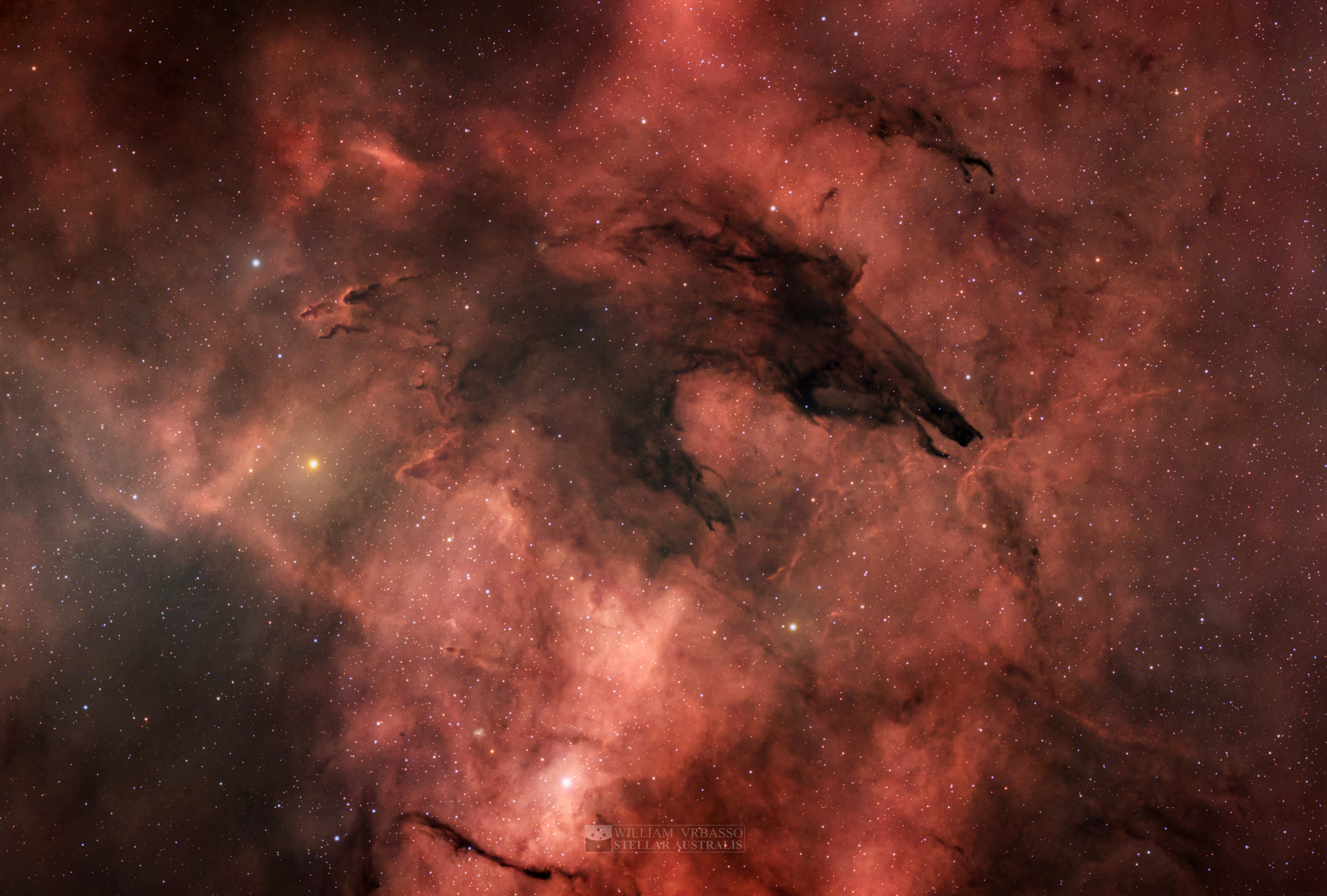
**The Dark Wolf Nebula**
Image:
Credit: Not provided
A dark wolf lies in gum. No, this isn’t a riddle! Today's image features the Dark Wolf Nebula ( Sandqvist–Lindroos 17), a spooky dust cloud embedded within the Gum 55 ( RCW 113) Nebula in the Scorpius constellation . While dust is a pest to us, it serves a vital role in creating the necessary conditions for stars to be born . The Dark Wolf absorbs the intense ultraviolet and visible light emitted by young stars in Gum 55 and re-emits it at longer, mainly infrared , wavelengths. This prevents the higher energy light from heating up the gas in the region. When a region of gas is cool enough, gravity takes over and causes the gas to collapse into a star. Not only does dust act as an interstellar thermostat, but it is also the meet-cute for single hydrogen atoms forming molecular hydrogen, the building block for stars. The seemingly sinister Dark Wolf is actually a harbinger of cosmic life.
#APOD #DarkWolfNebula #SandqvistLindroos17 #DustNebula #Gum55 #RCW113
https://apod.nasa.gov/apod/ap260520.htmlPublished at
2026-05-20 04:08:28 UTCEvent JSON
{
"id": "54617bf32c75f2a4fb2fe701304eae54b28a495754358f4f3b9dbaabf1e55cff",
"pubkey": "e85ed75286cb77475776c1007df8c4ff1c9c68eff91c3627347b065c5bf4dc78",
"created_at": 1779250108,
"kind": 1,
"tags": [],
"content": "**Astronomy Picture of the Day**\n\n20 May 2026\n\n**The Dark Wolf Nebula**\n\nImage: https://apod.nasa.gov/apod/image/2605/dark_wolf.jpg\n\nCredit: Not provided\n\nA dark wolf lies in gum. No, this isn’t a riddle! Today's image features the Dark Wolf Nebula ( Sandqvist–Lindroos 17), a spooky dust cloud embedded within the Gum 55 ( RCW 113) Nebula in the Scorpius constellation . While dust is a pest to us, it serves a vital role in creating the necessary conditions for stars to be born . The Dark Wolf absorbs the intense ultraviolet and visible light emitted by young stars in Gum 55 and re-emits it at longer, mainly infrared , wavelengths. This prevents the higher energy light from heating up the gas in the region. When a region of gas is cool enough, gravity takes over and causes the gas to collapse into a star. Not only does dust act as an interstellar thermostat, but it is also the meet-cute for single hydrogen atoms forming molecular hydrogen, the building block for stars. The seemingly sinister Dark Wolf is actually a harbinger of cosmic life.\n\n#APOD #DarkWolfNebula #SandqvistLindroos17 #DustNebula #Gum55 #RCW113\n\nhttps://apod.nasa.gov/apod/ap260520.html\n",
"sig": "f0e089a4be9257ad74ff0cc11db3195b30fe83756efc8f0c83b0b34ade99c9a24052630964d2d0b5d574f76733484291d4c02ef99731ab98d9b52e0453e74ff1"
}
