Event JSON
{
"id": "52bf304885f0f648a162dc776e7b4ec9434f5b901f369fd71832f156dc2d82b4",
"pubkey": "f06c0d239b29f2884d1a345bd1e120125610976d968e6002bb324116b70fc39e",
"created_at": 1741204383,
"kind": 1,
"tags": [
[
"imeta",
"url https://m.universetoday.com/system/media_attachments/files/114/111/570/481/388/973/original/96f94738a696e610.jpg",
"m image/jpeg"
],
[
"proxy",
"https://m.universetoday.com/@fraser/114111570491485192",
"web"
],
[
"proxy",
"https://m.universetoday.com/users/fraser/statuses/114111570491485192",
"activitypub"
],
[
"L",
"pink.momostr"
],
[
"l",
"pink.momostr.activitypub:https://m.universetoday.com/users/fraser/statuses/114111570491485192",
"pink.momostr"
],
[
"-"
]
],
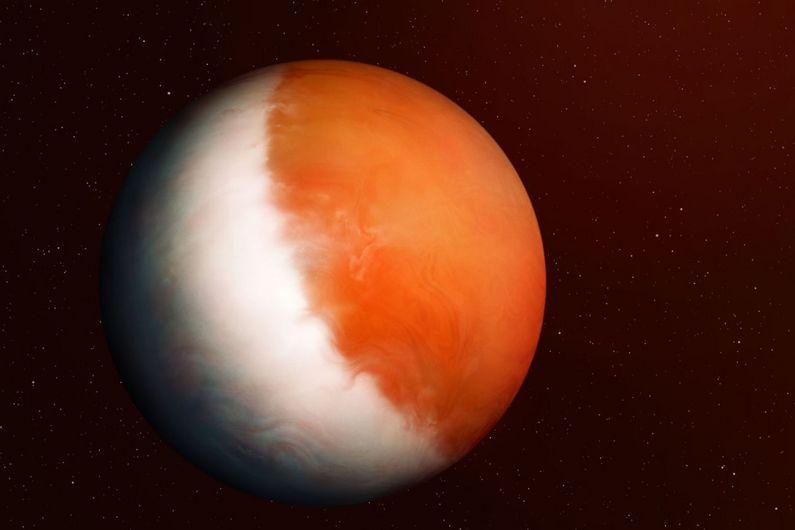
"content": "Astronomers have used JWST to image a bizarre ultra-hot Neptune exoplanet, revealing a dramatic difference in its hemispheres. The planet orbits so close to its star that it is \"tidally locked,\" always showing the same side to the star. Temperatures reach 2000°C on the dayside but are cooler and darker on the other side. According to their observations, astronomers say the dayside has bright reflective clouds on its cooler western hemisphere but not on its eastern side.\n\nhttps://nouvelles.umontreal.ca/en/article/2025/02/25/today-s-forecast-partially-cloudy-skies-on-an-ultra-hot-neptune/\nhttps://m.universetoday.com/system/media_attachments/files/114/111/570/481/388/973/original/96f94738a696e610.jpg\n",
"sig": "fa517b05b6931c7fbce1f5442a0154a932142df72b4b8fa378419ffa98d798a68fb85ad3324db68b0f2ed5f3f0360e7e0cfb0d38930cbfd44574f70d837f0809"
}