APOD on Nostr: **Astronomy Picture of the Day** 25 May 2026 **Thackeray's Globules** Image: Credit: ...
**Astronomy Picture of the Day**
25 May 2026
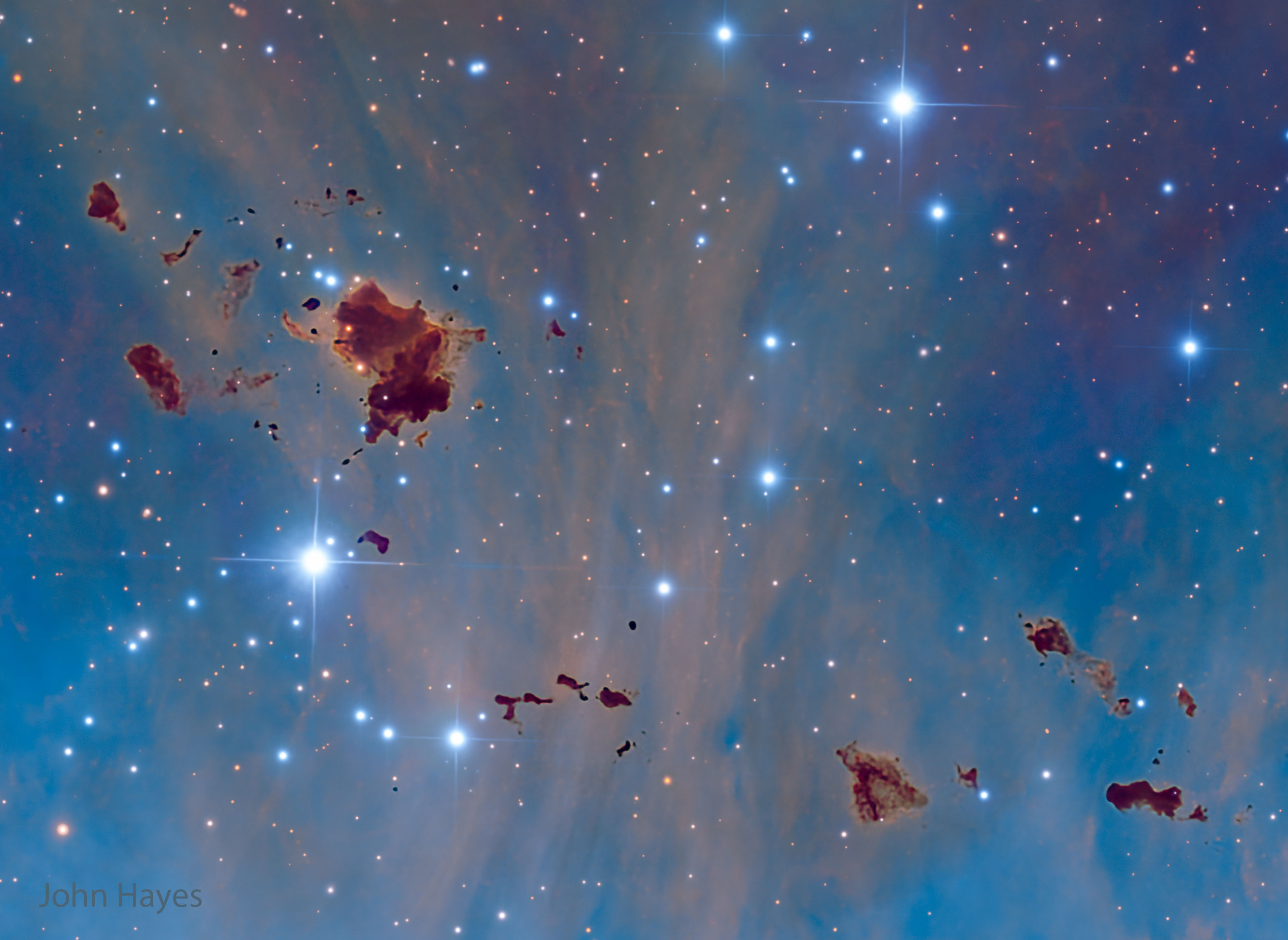
**Thackeray's Globules**
Image:
Credit: Not provided
What are these strange space globs? Situated in rich star field s and glowing hydrogen gas, these opaque clouds of interstellar dust and gas are so large they might be able to form stars. Their home is known as IC 2944 , a bright stellar nursery located about 7,600 light years away toward the constellation of the Centaur ( Centaurus ). The largest of these dark globules , first spotted by A. D. Thackeray in 1950 using a telescope in South Africa , is likely two separate but overlapping clouds, each more than one light-year wide. Along with other data, the featured Hubble palette image from the El Sauce Observatory in Chile, indicates that Thackeray's globules are fractured and churning as a result of intense ultraviolet radiation from young, hot stars already energizing and heating the bright emission nebula . These and similar dark globules known to be associated with other star forming regions may ultimately be dissipated by their hostile environment -- like cosmic lumps of butter in a hot frying pan .
#APOD #ThackeraysGlobules #IC2944 #Centaurus #StarNursery #StarFormation
https://apod.nasa.gov/apod/ap260525.htmlPublished at
2026-05-25 04:09:39 UTCEvent JSON
{
"id": "ae043ccafccf5258b0098c45d348b03e23344f651b574d77d608fa2c53b9b695",
"pubkey": "e85ed75286cb77475776c1007df8c4ff1c9c68eff91c3627347b065c5bf4dc78",
"created_at": 1779682179,
"kind": 1,
"tags": [],
"content": "**Astronomy Picture of the Day**\n\n25 May 2026\n\n**Thackeray's Globules**\n\nImage: https://apod.nasa.gov/apod/image/2605/ThackerayGlobs_Hayes_2664.jpg\n\nCredit: Not provided\n\nWhat are these strange space globs? Situated in rich star field s and glowing hydrogen gas, these opaque clouds of interstellar dust and gas are so large they might be able to form stars. Their home is known as IC 2944 , a bright stellar nursery located about 7,600 light years away toward the constellation of the Centaur ( Centaurus ). The largest of these dark globules , first spotted by A. D. Thackeray in 1950 using a telescope in South Africa , is likely two separate but overlapping clouds, each more than one light-year wide. Along with other data, the featured Hubble palette image from the El Sauce Observatory in Chile, indicates that Thackeray's globules are fractured and churning as a result of intense ultraviolet radiation from young, hot stars already energizing and heating the bright emission nebula . These and similar dark globules known to be associated with other star forming regions may ultimately be dissipated by their hostile environment -- like cosmic lumps of butter in a hot frying pan .\n\n#APOD #ThackeraysGlobules #IC2944 #Centaurus #StarNursery #StarFormation\n\nhttps://apod.nasa.gov/apod/ap260525.html\n",
"sig": "524be5b4b9f5e77a944f7f42dffeffa79ba99a9d11d5ddb75708dbcf3d21a1812a1ababe5a2ba39b337ffaef1bf4971e8a12bda323cb88564bdf2b03cb716aed"
}
