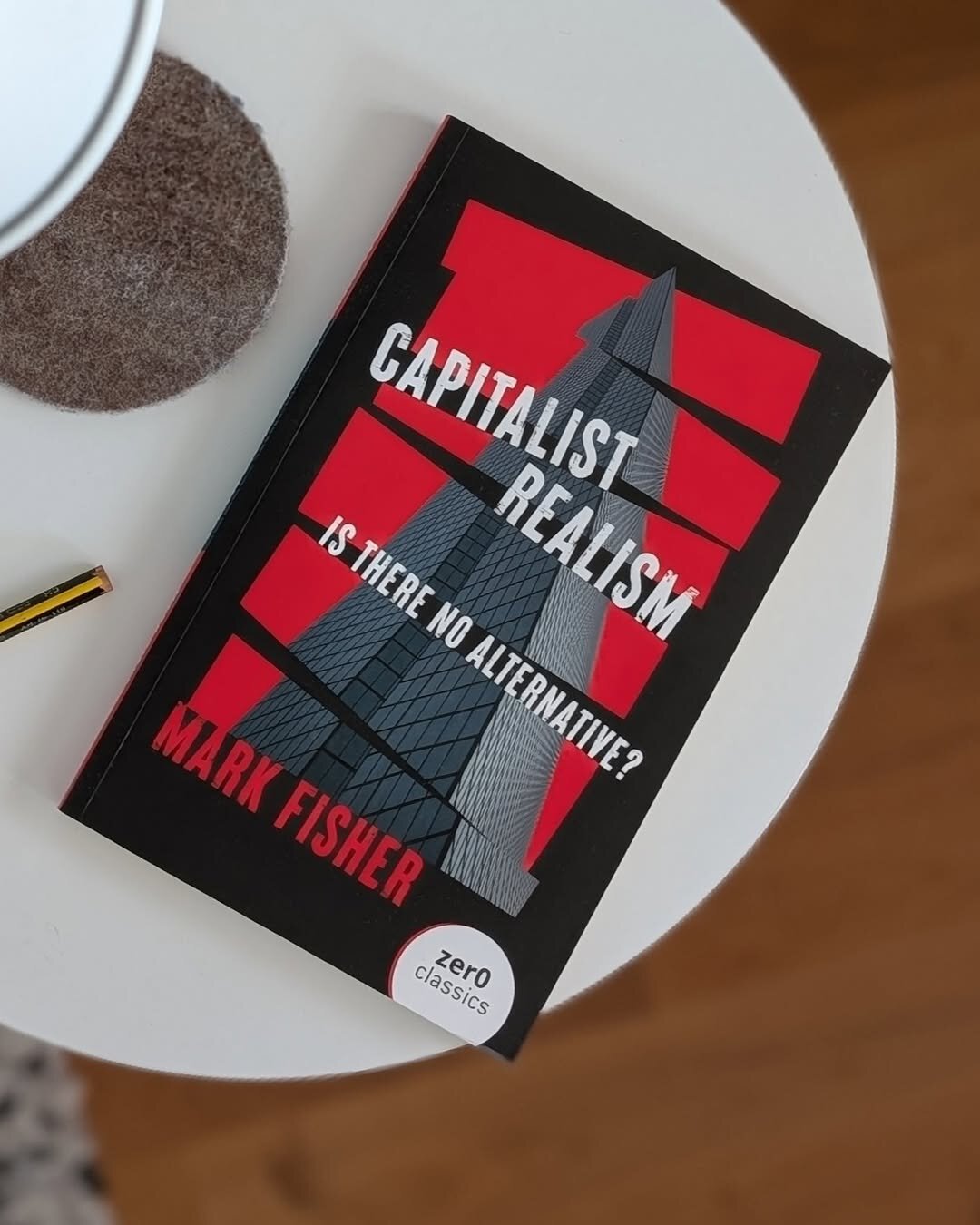
malteengeler on Nostr: I read "Capitalist Realism" the first time years ago. I recently re-read it and still ...
I read "Capitalist Realism" the first time years ago. I recently re-read it and still love it tremendously. It still speaks to me and probably does so to everyone who feels the crushing weight of a reality that is inherently de-humanizing.
Fisher's words still manage to catch the suffocating impact of neoliberalism on culture, academics and arts, just take this part:
„Capitalism is what is left when beliefs have collapsed at the level of ritual or symbolic elaboration, and all that is left is the consumer-spectator, trudging through the ruins and the relics. Yet this turn from belief to aesthetics, from engagement to spectatorship, is held to be one of the virtues of capitalist realism. [...] Capitalist realism presents itself as a shield protecting us from the perils posed by belief itself. […] „The ‘realism’ here is analogous to the deflationary perspective of a depressive who believes that any positive state, any hope, is a dangerous illusion.“
These words of course can't really be read without taking into account what the author itself struggled with personally. That is why the book - to me - has also become a reminder to not stare into the abyss for too long. As Jathan Sadowski said in an episode of the "This Machine Kills"-podcast: "We must look at the abyss, analyze the abyss, but we can not get lost in the abyss."
The final (most famous) sentence of Fisher's book says: "From a situation in which nothing can happen, suddenly anything is possible again." And this is what I personally try to come back to. Being politically active in this historical stage of capitalism can feel like an unending onslaught on our capability to hope and to imagine the better world we fight for. We might fail more often than not. But, as Ewa Majewska (Feminist Antifascism, 2021) reminds us (citing Rosa Luxemburg):
"Failure is inevitable, and it should be experienced as a part of the process of building alternatives to capitalism, not as proof of the futility of such efforts."
Published at
2026-02-12 13:47:22 UTCEvent JSON
{
"id": "ab38aab5a45e87e8d50ff29b908b46d6635edd7d9e46b3b152d357161ad2a262",
"pubkey": "cc1a5ee81cbc7d538d93abc78c466edb0ad3e45ecb51b765fe3238d17d8e2ecb",
"created_at": 1770904042,
"kind": 1,
"tags": [
[
"imeta",
"url https://pxscdn.com/public/m/_v2/911146210670006088/fbedcc803-0ec729/fqzmRXdheJsU/qMhcJkAZ54gTEfe5ixrCPnHI2EUyz4yu5NMf7DBZ.jpg",
"m image/jpeg"
],
[
"proxy",
"https://pixelfed.social/p/malteengeler/927558763979915960",
"web"
],
[
"proxy",
"https://pixelfed.social/p/malteengeler/927558763979915960",
"activitypub"
],
[
"L",
"pink.momostr"
],
[
"l",
"pink.momostr.activitypub:https://pixelfed.social/p/malteengeler/927558763979915960",
"pink.momostr"
],
[
"-"
]
],
"content": "I read \"Capitalist Realism\" the first time years ago. I recently re-read it and still love it tremendously. It still speaks to me and probably does so to everyone who feels the crushing weight of a reality that is inherently de-humanizing.\n\n\n\nFisher's words still manage to catch the suffocating impact of neoliberalism on culture, academics and arts, just take this part:\n\n\n\n„Capitalism is what is left when beliefs have collapsed at the level of ritual or symbolic elaboration, and all that is left is the consumer-spectator, trudging through the ruins and the relics. Yet this turn from belief to aesthetics, from engagement to spectatorship, is held to be one of the virtues of capitalist realism. [...] Capitalist realism presents itself as a shield protecting us from the perils posed by belief itself. […] „The ‘realism’ here is analogous to the deflationary perspective of a depressive who believes that any positive state, any hope, is a dangerous illusion.“\n\n\n\nThese words of course can't really be read without taking into account what the author itself struggled with personally. That is why the book - to me - has also become a reminder to not stare into the abyss for too long. As Jathan Sadowski said in an episode of the \"This Machine Kills\"-podcast: \"We must look at the abyss, analyze the abyss, but we can not get lost in the abyss.\"\n\n\n\nThe final (most famous) sentence of Fisher's book says: \"From a situation in which nothing can happen, suddenly anything is possible again.\" And this is what I personally try to come back to. Being politically active in this historical stage of capitalism can feel like an unending onslaught on our capability to hope and to imagine the better world we fight for. We might fail more often than not. But, as Ewa Majewska (Feminist Antifascism, 2021) reminds us (citing Rosa Luxemburg):\n\n\n\n\"Failure is inevitable, and it should be experienced as a part of the process of building alternatives to capitalism, not as proof of the futility of such efforts.\"\nhttps://pxscdn.com/public/m/_v2/911146210670006088/fbedcc803-0ec729/fqzmRXdheJsU/qMhcJkAZ54gTEfe5ixrCPnHI2EUyz4yu5NMf7DBZ.jpg\n",
"sig": "ad4be1654c1f74de0a9ea8764e870b4159a65d4c008f54ff830ee2da48e2685e0a170f9793eca763545ea5bdf3de98c28b5b4fd0f235d8b00b66af0a4c0d4d34"
}