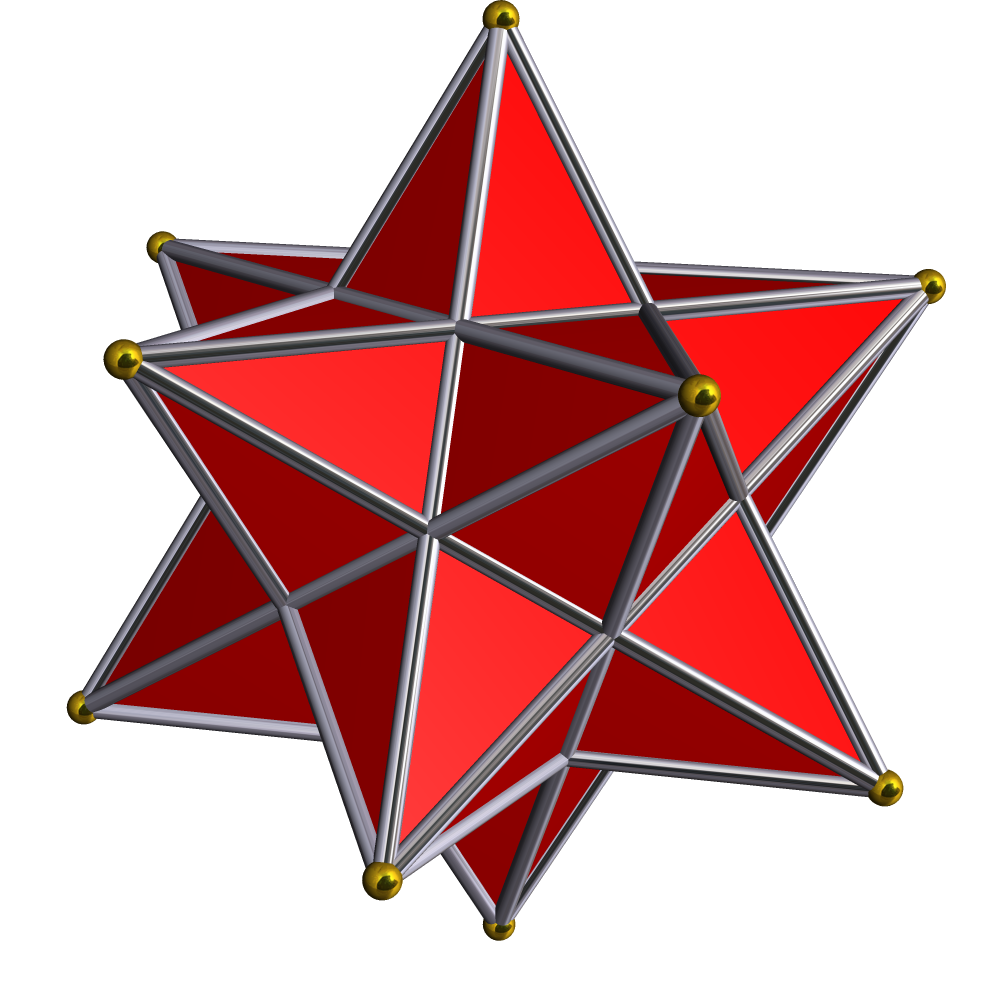
I don't actually know this! What I know is that the small stellated dodecahedron is a branched cover of the Riemann sphere by a Riemann surface of genus 4:
https://blogs.ams.org/visualinsight/2016/06/15/small-stellated-dodecahedron/
The theory of this stuff makes me think the great icosahedron is a branched cover of the Riemann sphere by itself. For example, Wikipedia lists the Euler characteristic of the great icosahedron as being 2, like the sphere's:
https://en.wikipedia.org/wiki/Kepler%E2%80%93Poinsot_polyhedron
Perhaps this leads in a different direction than the one I wanted to explore today... or perhaps it's related.