Event JSON
{
"id": "ab4681d671a774adc2b41438642906daf6a88187d6902ff1323148effc9eea34",
"pubkey": "563821004c3e4e4f4fbef74a2657db3299a0e71a78214bf97db0b6ca05fb73d3",
"created_at": 1732675607,
"kind": 1,
"tags": [
[
"proxy",
"https://mathstodon.xyz/@gregeganSF/113552628637326550",
"web"
],
[
"imeta",
"url https://media.mathstodon.xyz/media_attachments/files/113/552/596/328/062/847/original/5c2f06a9b5294af3.png",
"m image/png"
],
[
"proxy",
"https://mathstodon.xyz/users/gregeganSF/statuses/113552628637326550",
"activitypub"
],
[
"L",
"pink.momostr"
],
[
"l",
"pink.momostr.activitypub:https://mathstodon.xyz/users/gregeganSF/statuses/113552628637326550",
"pink.momostr"
],
[
"-"
]
],
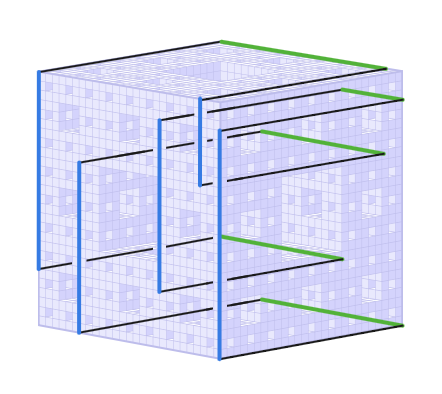
"content": "In 1926, Menger proved that you can embed any compact 1-dimensional space in his famous fractal sponge, including a loop, but he didn’t say anything about the knottedness of the embedded loop.\n\nNow three teenagers and their mentor have proved that you can actually embed any *knot* in the Menger sponge: you can deform any knot without the string having to pass through itself so that it ends up as a subset of the Menger sponge.\n\nhttps://www.quantamagazine.org/teen-mathematicians-tie-knots-through-a-mind-blowing-fractal-20241126/\n\nhttps://arxiv.org/abs/2409.03639\nhttps://media.mathstodon.xyz/media_attachments/files/113/552/596/328/062/847/original/5c2f06a9b5294af3.png\n",
"sig": "3e387aa346f841c856212dbd0ce763cef4a2c3aa9d8fc745de34e8c993f16b98355e8e429af0e7f450a197096a1a707025764b40af2551bc7b9558d66aa40e15"
}