John Carlos Baez on Nostr: The little red dots in the early universe could be 'quasi-stars'. Calculations show ...
The little red dots in the early universe could be 'quasi-stars'.
Calculations show such a star could form when a gas cloud that's heavier than 1,000 times the Sun's mass collapses and forms a black hole. Its outer layers would be big enough to absorb the resulting supernova without being blown apart. Then you'd have a star powered by gravity, with a black hole in the middle.
Such a star could be as luminous as a small present-day galaxy! And that's what little red dots are like.
As a quasi-star ages, it cools down and eventually the gas on the outside would dissipate, leaving behind a black hole. Such 'intermediate-mass black holes' could be the ancestors of the supermassive black holes we now see in the middles of most galaxies.
Pro tip:
Don't embarrass yourself by mixing up a quasi-star with a Thorne–Żytkow object! That's when a small black hole falls into an ordinary large star. We may have seen one of those in the Small Magellanic Cloud, a small galaxy orbiting the Milky Way.
Quasi-star:
https://en.wikipedia.org/wiki/Quasi-star Thorne–Żytkow object:
https://en.wikipedia.org/wiki/Thorne%E2%80%93%C5%BBytkow_object 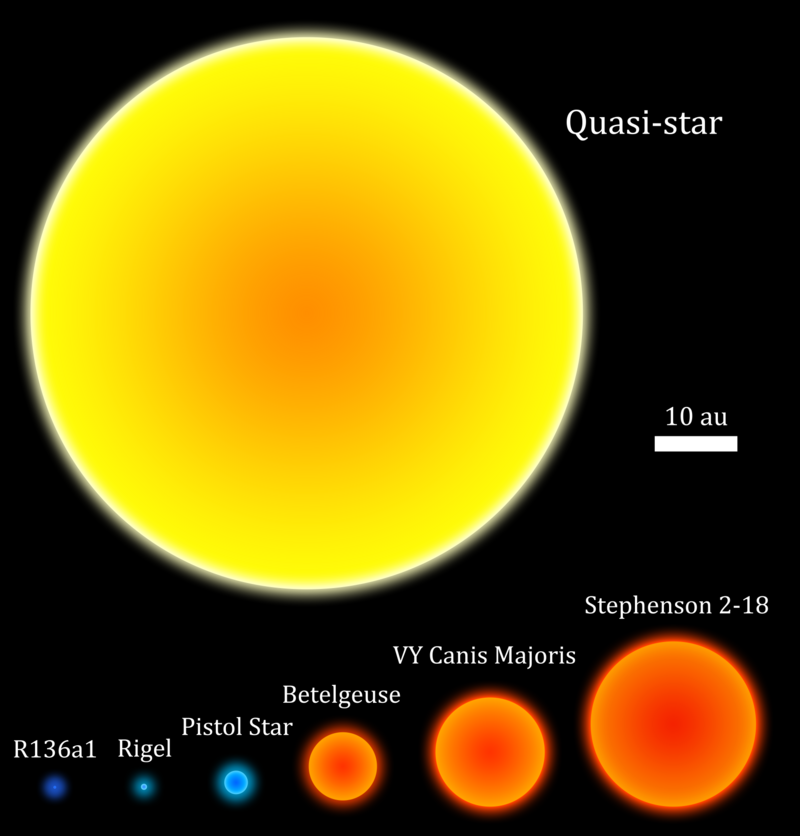
Published at
2025-09-14 09:55:39 UTCEvent JSON
{
"id": "a426d4c678006927b73a7f5d9413b59a67cfbd07255870f2f20dace46d796763",
"pubkey": "9a6a1a8eefd0b53d7e0c966ab35bd904151246f03b1be98fa0d2d0eeb4940320",
"created_at": 1757843739,
"kind": 1,
"tags": [
[
"proxy",
"https://mathstodon.xyz/@johncarlosbaez/115202047307065809",
"web"
],
[
"imeta",
"url https://media.mathstodon.xyz/media_attachments/files/115/201/919/759/344/866/original/6e0e2e8efc86075c.png",
"m image/png"
],
[
"proxy",
"https://mathstodon.xyz/users/johncarlosbaez/statuses/115202047307065809",
"activitypub"
],
[
"L",
"pink.momostr"
],
[
"l",
"pink.momostr.activitypub:https://mathstodon.xyz/users/johncarlosbaez/statuses/115202047307065809",
"pink.momostr"
],
[
"-"
]
],
"content": "The little red dots in the early universe could be 'quasi-stars'. \n\nCalculations show such a star could form when a gas cloud that's heavier than 1,000 times the Sun's mass collapses and forms a black hole. Its outer layers would be big enough to absorb the resulting supernova without being blown apart. Then you'd have a star powered by gravity, with a black hole in the middle.\n\nSuch a star could be as luminous as a small present-day galaxy! And that's what little red dots are like.\n\nAs a quasi-star ages, it cools down and eventually the gas on the outside would dissipate, leaving behind a black hole. Such 'intermediate-mass black holes' could be the ancestors of the supermassive black holes we now see in the middles of most galaxies.\n\nPro tip: \n\nDon't embarrass yourself by mixing up a quasi-star with a Thorne–Żytkow object! That's when a small black hole falls into an ordinary large star. We may have seen one of those in the Small Magellanic Cloud, a small galaxy orbiting the Milky Way.\n\nQuasi-star: https://en.wikipedia.org/wiki/Quasi-star\n\n Thorne–Żytkow object: https://en.wikipedia.org/wiki/Thorne%E2%80%93%C5%BBytkow_object\nhttps://media.mathstodon.xyz/media_attachments/files/115/201/919/759/344/866/original/6e0e2e8efc86075c.png\n",
"sig": "e73162f7020eccb04b9c0bc381c57d99937c4aabb438949eb4fa4b474dec0f9a6ad63dcba839c2d77c23154a22796f334400e761940704dffb93919914b75bf0"
}