Event JSON
{
"id": "a4b8234cce73c7a59fd696eb2d9d1b9f2a447501cd4b9677f499fcb5247133b7",
"pubkey": "b91911c01ae4d704a5ccb42923955e52e931c476f1787d91105ba9a2fc310a7e",
"created_at": 1740123058,
"kind": 1,
"tags": [
[
"t",
"hubble"
],
[
"t",
"galaxy"
],
[
"t",
"earth"
],
[
"t",
"astronomy"
],
[
"t",
"telescope"
],
[
"t",
"planet"
],
[
"imeta",
"url https://files.mastodon.bot/media_attachments/files/114/040/665/523/461/259/original/f552f438e64ce3f0.jpg",
"m image/jpeg",
"dim 1024x678",
"blurhash UMC~h#0Mxun$58%1V@R+4.-:M|t6^iE2t7f6"
],
[
"proxy",
"https://mastodon.bot/users/apod/statuses/114040704759731287",
"activitypub"
]
],
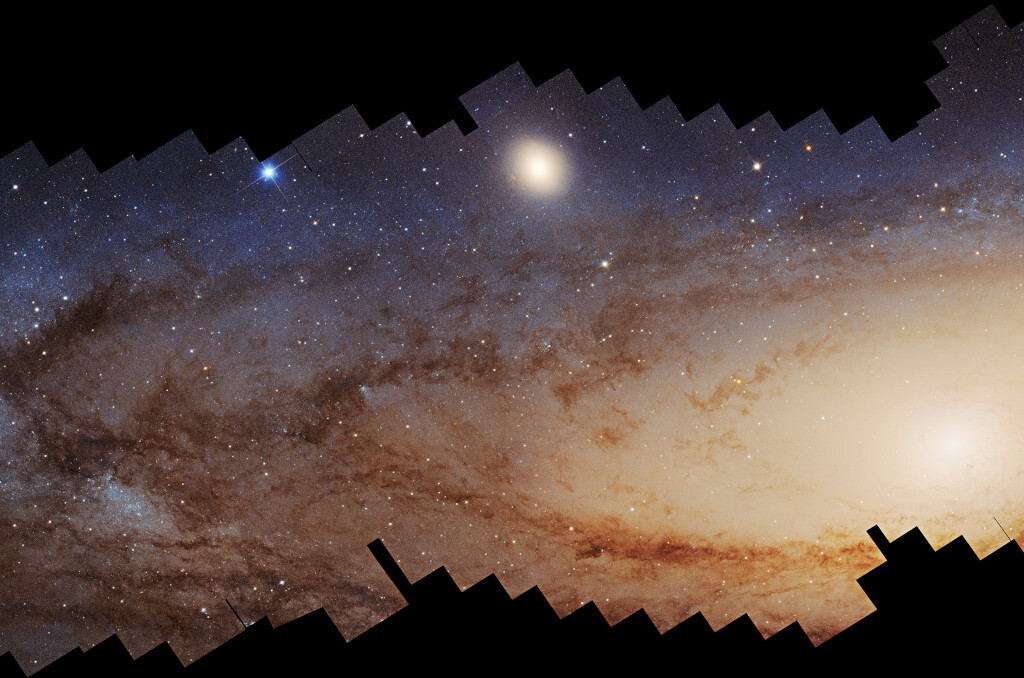
"content": "APOD from 2025-02-21\n\n#Hubble's Andromeda #Galaxy Mosaic\n\nHubble's largest photomosaic of the Andromeda Galaxy spans nearly six full moons in #Earth's sky. Comprising 600 frames from 2010-2022, it reveals the galaxy's core and spiral arms. At 2.5 million light-years away, M31 is our closest large spiral neighbor, offering insights into galaxy structure and evolution.\n\nHD image at https://apod.nasa.gov/apod/ap250221.html#space #astronomy #telescope #planet\n\nhttps://files.mastodon.bot/media_attachments/files/114/040/665/523/461/259/original/f552f438e64ce3f0.jpg",
"sig": "bd4f2c5b59f4100925b1c28d539a12182ed50d5776ec124627bce2512230fb54d12d432a15dd33412871a3575a6dfed541084ce799281f26fecd215ac50a382b"
}