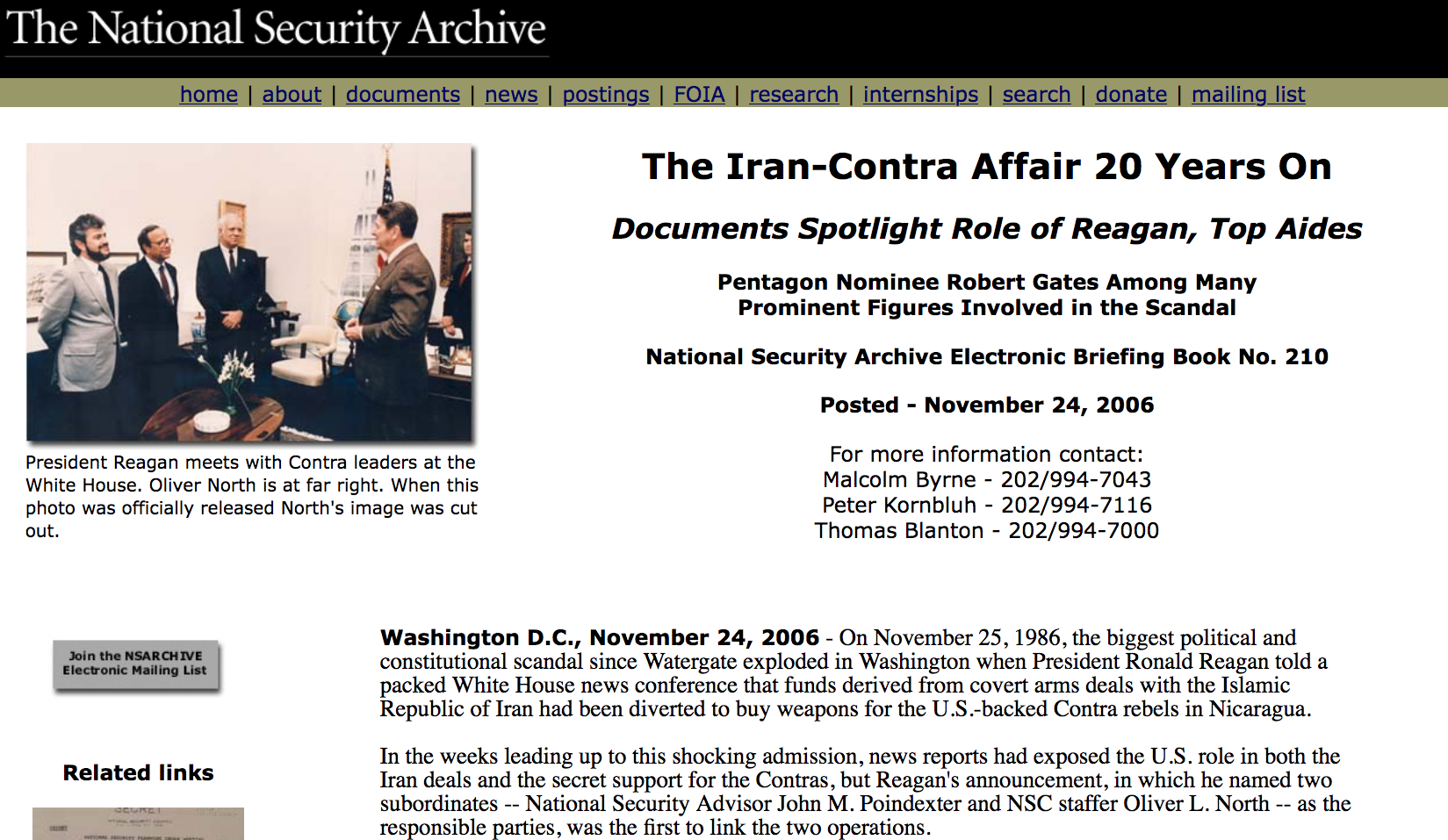
This sampling of some of the most revealing documentation (Note 1) to come out of the affair gives a clear indication of how deeply involved the president was in terms of personally directing or approving different aspects of the affair. The list of other officials who also played significant parts, despite their later denials, includes Vice President George H.W. Bush, Secretary of State George P. Shultz, Secretary of Defense Caspar W. Weinberger, CIA Director William J. Casey, White House Chief of Staff Donald T. Regan, and numerous other senior and mid-level officials, making this a far broader scandal than the White House portrayed it at the time.
In that connection, what follows is a partial list of some of the more prominent individuals who were either directly a part of the Iran-Contra events or figured in some other way during the affair or its aftermath:
Elliott Abrams - currently deputy assistant to President Bush and deputy national security advisor for global democracy strategy, Abrams was one of the Reagan administration's most controversial figures as the senior State Department official for Latin America in the mid-1980s. He entered into a plea bargain in federal court after being indicted for providing false testimony about his fund-raising activities on behalf of the Contras, although he later accused the independent counsel's office of forcing him to accept guilt on two counts. President George H. W. Bush later pardoned him.
David Addington - now Vice President Cheney's chief of staff, and by numerous press accounts a stanch advocate of expanded presidential power, Addington was a congressional staffer during the joint select committee hearings in 1986 who worked closely with Cheney.
John Bolton - the controversial U.N. ambassador whose recess appointment by President Bush is now in jeopardy was a senior Justice Department official who participated in meetings with Attorney General Edwin Meese on how to handle the burgeoning Iran-Contra political and legal scandal in late November 1986. There is little indication of his precise role at the time.
Richard Cheney - now the vice president, he played a prominent part as a member of the joint congressional Iran-Contra inquiry of 1986, taking the position that Congress deserved major blame for asserting itself unjustifiably onto presidential turf. He later pointed to the committees' Minority Report as an important statement on the proper roles of the Executive and Legislative branches of government.
Robert M. Gates - President Bush's nominee to succeed Donald Rumsfeld, Gates nearly saw his career go up in flames over charges that he knew more about Iran-Contra while it was underway than he admitted once the scandal broke. He was forced to give up his bid to head the CIA in early 1987 because of suspicions about his role but managed to attain the position when he was re-nominated in 1991. (See previous Electronic Briefing Book)
Manuchehr Ghorbanifar - the quintessential middleman, who helped broker the arms deals involving the United States, Israel and Iran ostensibly to bring about the release of American hostages being held in Lebanon, Ghorbanifar was almost universally discredited for misrepresenting all sides' goals and interests. Even before the Iran deals got underway, the CIA had ruled Ghorbanifar off-limits for purveying bad information to U.S. intelligence. Yet, in 2006 his name has resurfaced as an important source for the Pentagon on current Iranian affairs, again over CIA objections.
Michael Ledeen - a neo-conservative who is vocal on the subject of regime change in Iran, Ledeen helped bring together the main players in what developed into the Iran arms-for-hostages deals in 1985 before being relegated to a bit part. He reportedly reprised his role shortly after 9/11, introducing Ghorbanifar to Pentagon officials interested in exploring contacts inside Iran.
Edwin Meese - currently a member of the blue-ribbon Iraq Study Group headed by James Baker and Lee Hamilton, he was Ronald Reagan's controversial attorney general who spearheaded an internal administration probe into the Iran-Contra connection in November 1986 that was widely criticized as a political exercise in protecting the president rather than a genuine inquiry by the nation's top law enforcement officer.
https://nsarchive2.gwu.edu/NSAEBB/NSAEBB210/index.htm
https://nsarchive.gwu.edu/briefing-book/iran/2016-11-25/iran-contra-affair-30-years-later-milestone-post-truth-politics
https://nsarchive.gwu.edu/events/iran-contra-affair-1985-1994?page=1