I regularly get people claiming that nuclear is the most expensive thing ever. Institutions like IEA however point out that nuclear power plants that are fully debt free produce the cheapest form of energy we know. Who is right?
To understand this conundrum you need to understand two terms from the field: CAPEX and OPEX. The first are about capital costs, the latter is about operational costs.
Capital costs are essentially two things: the building costs of a nuclear power plant, these are also known as the 'overnight costs', and the interest on the loan that was given to build the unit.
This interest rate can be high or low, and that alone makes a huge difference in the kWh price on your bill! Hinkley Point C for example, a nuclear project in the UK, is often cited as *the* example of nuclear energy being expensive, but 65% of all costs is mere compounded interest.
Suffice to say that nuclear builds benefit from low interest rates. The more confidence financiers have in the project, the lower the interest. The less confidence they have, or the higher the 'risk', the higher the interest.
State loans or guarantees are one way to solve that in the short term. In the longer term, confidence is created by having more successful builds.
Building costs themselves are also a factor. In the West we haven't actually built many new nuclear reactors in decades. Back when we did, like during the Messmer plan in the France in the 1970s and 80s, we had strong established supply lines, an experienced workforce and standardised designs. This all led to cheap builds.
Nowadays we have been building newer designs by trial and error and solved many little problems along the way. These issues caused building times to be longer than anticipated and therefore costs to continue to rise.
By now we do have experience with the designs, like the EPR and the AP1000. If we decided to build dozens of them, scalability effects kick in and nuclear reactors go from one off 'projects' to 'mass products', thus dropping costs again.
But once a unit has been built, it also costs money to operate and maintain it. Workers have to be paid. Fuel has to be bought. The OPEX is around €80 million a year for a 1 GWe unit.
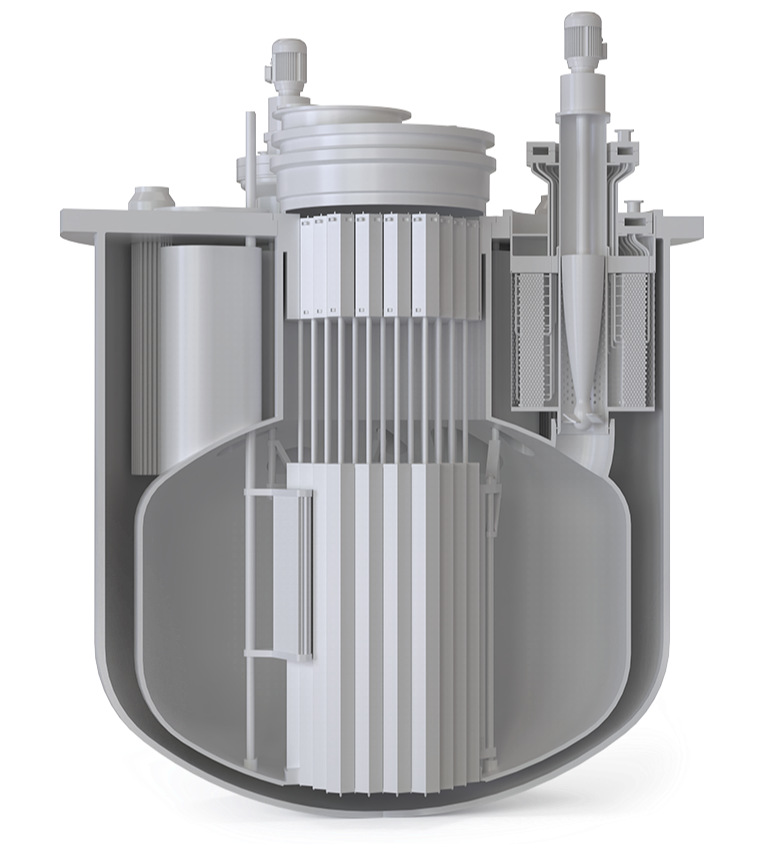
Knowing all this, let's do a thought experiment about costs with the Newcleo lead-cooled fast reactor, one of the advanced designs that'll hit the market in the next decade.
Last January, Newcleo signed a contract to build four units in Slovakia for a total of €3.2 billion capital costs. Let's assume the €80 million OPEX stays the same. Let's further assume they have to pay their debt in a timespan of 30 years. And since it is a 200 MWe reactor, let's assume something close to 90% capacity factor, something that's usual for nuclear energy, and therefore 1.5 TWh of produced electricity annually.
With an interest rate of 7% and monthly payments, we get to a total of €1.9 billion CAPEX over 30 years, or €65 million a year. With OPEX added that's €145 million in total. Divide this by 1.5 TWh and you get to 9.6 cents per kWh.
If we assume a low interest scenario of 2% the price drops to 7.6 cents / kWh.
If the debt is fully paid off the price drops further to 5.3 cents.
And this is assuming the same OPEX as a 1 GWe reactor. It's unlikely to be this high really as fuel in a fast reactor is used two orders more efficiently and you probably need less personnel. Maintenance might be somewhat higher though compared to a conventional PWR.
I couldn't find numbers on what Newcleo thinks the OPEX will be, but if we assume €40 million a year, this translates to 2.6 cents per kWh for a fully paid off reactor that has a design lifetime of 60 years, making it indeed the cheapest form of energy as IEA also states.
This leaves costs for decommissioning and storage of minuscule waste (about 100x less than at a conventional plant). Let's add 1 cent for that.
This leaves us at 3.6 to 10.6 cents per kWh. This is well within the cost margins of other energy sources, including renewables.
If you ever encounter someone saying that nuclear is "too expensive", I hope this can give you some context!